Echoes of Earth mod: Overview and features
Introduction to Echoes of Earth
- You can download the mod from its workshop page
- Alternative download[forums.civfanatics.com] location from CivFanatics.
- Reddit discussion thread[redd.it] on /r/civbeyondearth
- CivFanatics discussion thread[forums.civfanatics.com].
- Development blog[mechanicsasmetaphor.wordpress.com]. Contains behind the scenes info and sneak peaks at future versions.
In the twilight of Earth's great civilizations, we were chosen to venture to the stars in search of a new home. But we did not travel alone. As we slept, behind us streaked messages from Earth. Their dream that we would not let the light of humanity extinguish. When we awoke we listened to words spoken centuries ago. As we gazed across the vast space and time that separated us, we hoped that Earth still lived and that the words were not the echoes of ghosts.
The Signal from Old Earth
In Echoes of Earth, the seedships did not leave alone. After launching the seedships, Earth launched a chain of satellites and used them to send messages ahead of the colonists. These satellites allowed Earth to send one way messages to the seedships that the colonists would be able to read upon landing. These messages contained the history of Earth after the seedships left, discoveries Earth hoped would help the colonists, and all the failed research on instantaneous communication.
The Signal is one of the core new mechanics in Echoes of Earth. From the start of the game two new buildings, the Signal Collector and Signal Decoder, provide a source of Science and Culture to boost your early game. Data from Earth will allow breakthroughs that provide your colony bursts of Production, Energy, or more depending on your pre-game loadout choice.
But the Signal will not last forever. The colony needs to build its own LaserComm Satellites to help maintain the connection. If the colony does not, then the transmission capability will be compromised and the bonuses will be reduced. As time passes the situation on Earth becomes more and more desperate and the content of the Signal becomes more haunting. Until the day when the Signal goes silent and calls the fate of Earth into question -- are they gone for good, or can the colony find a way to save humanity's first home?
- Free Technology upon landing
- Turns 10, 20, 30: Get a bonus depending on your loadout choice
- Turn 50: If the player hasn't launched a LaserComm Satellite, the Signal weakens until player launches a LaserComm Satellite
- Turn 100: The Signal ends, even if the player has launched a LaserComm Satellite
- Signal Collectors, Signal Decoders and Signal Archivers are cheaper to build in cities that are founded later
The free Technology at the start of the game lets you adapt to your immediate surroundings. If you don't have access to a river for Farms, then you can get Biology so that you can build Growlabs quickly. Or if your loadout lets you see Titanium and there are tiles with the resource nearby, you can take Engineering as your free tech to get the Titanium mine up and running faster.
The Signal provides a way to jump start your economy in the early game. But since its benefits don't last forever, you will need to use this early edge wisely and prepare your economy for the period after the Signal ends.
Technology Web
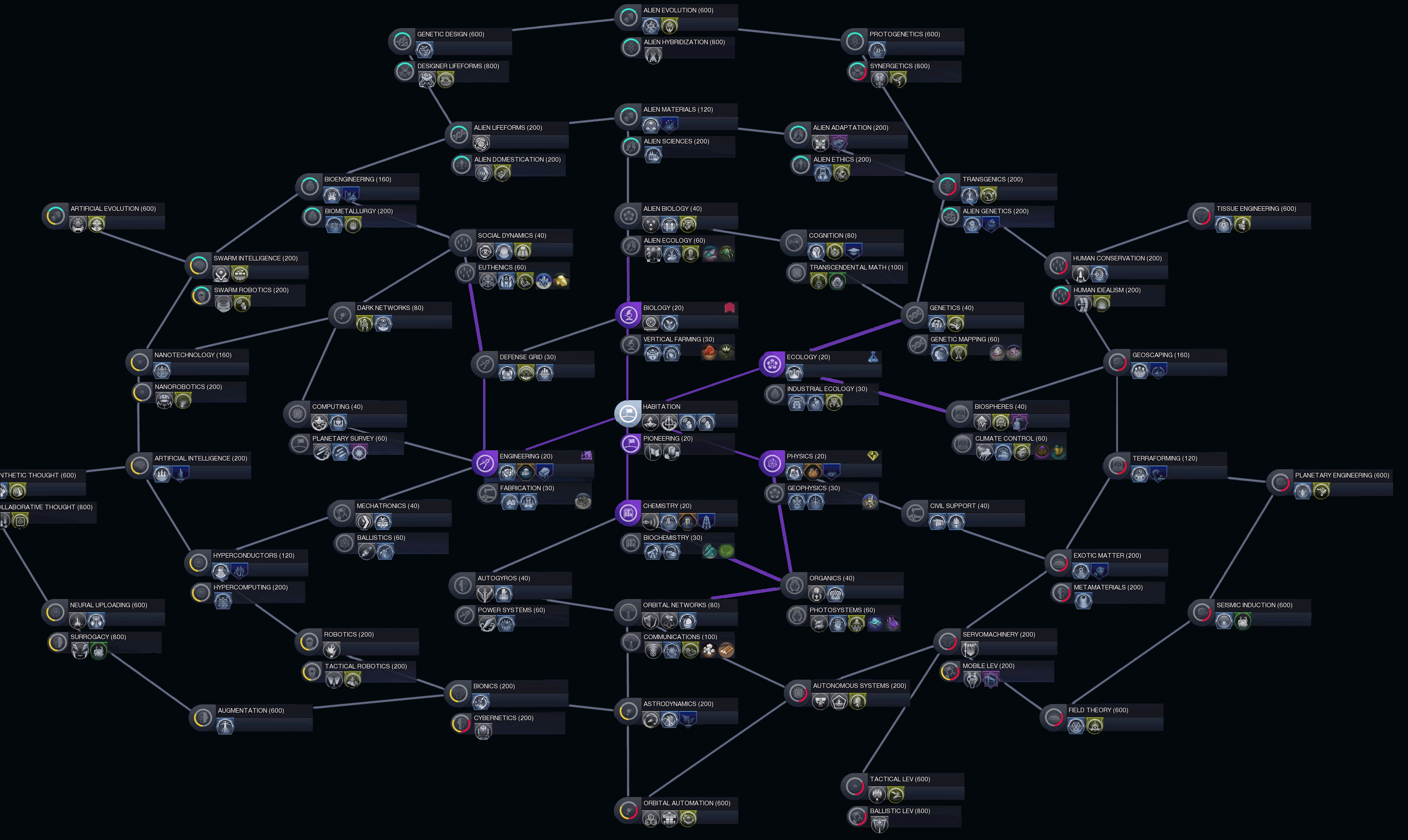
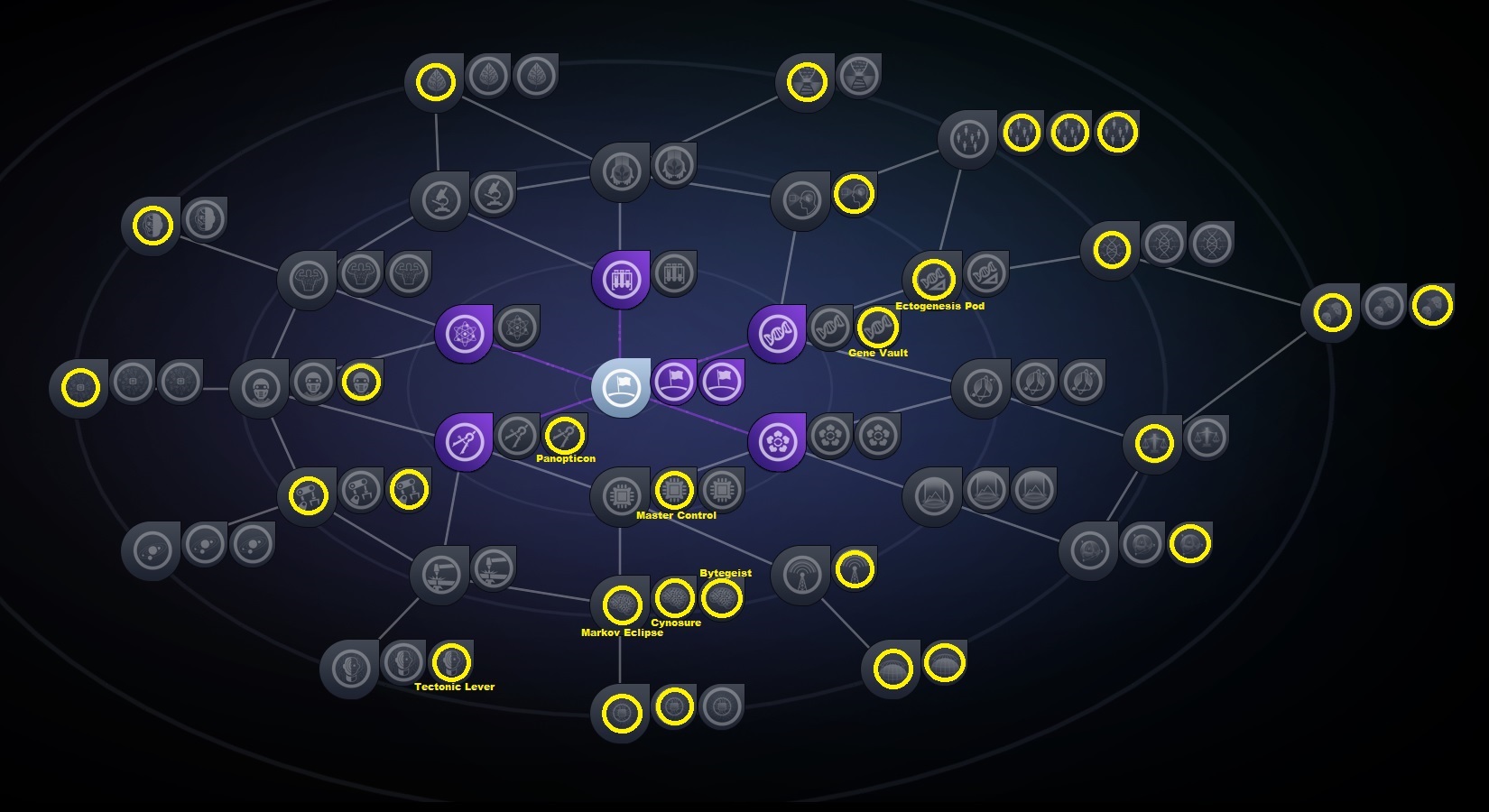
The technology web has been completely reorganized into a flatter, more specialized format, containing more branches and fewer leaves. This gives you better access to critical technologies that will help your colony grow. In the early game, leaf technologies unlock buildings that are highly dependent on the terrain and resources within your colony. Which technology you want to research will depend greatly on your colony and its surroundings.
Late game technology choices are highly connected to which Affinity you are developing along. Harmony technologies are clustered in the top of the tech web with Purity in the lower right and Supremacy in the lower left. If your colony is developing along the Purity path, you may still grab a tech or two outside of Purity, but you likely won't want to dedicate the effort to getting deep techs in the other Affinity areas. As an example, while you may miss out on the utility of Phasal Transporters, you'll have easy access to Magrails.
Loadouts
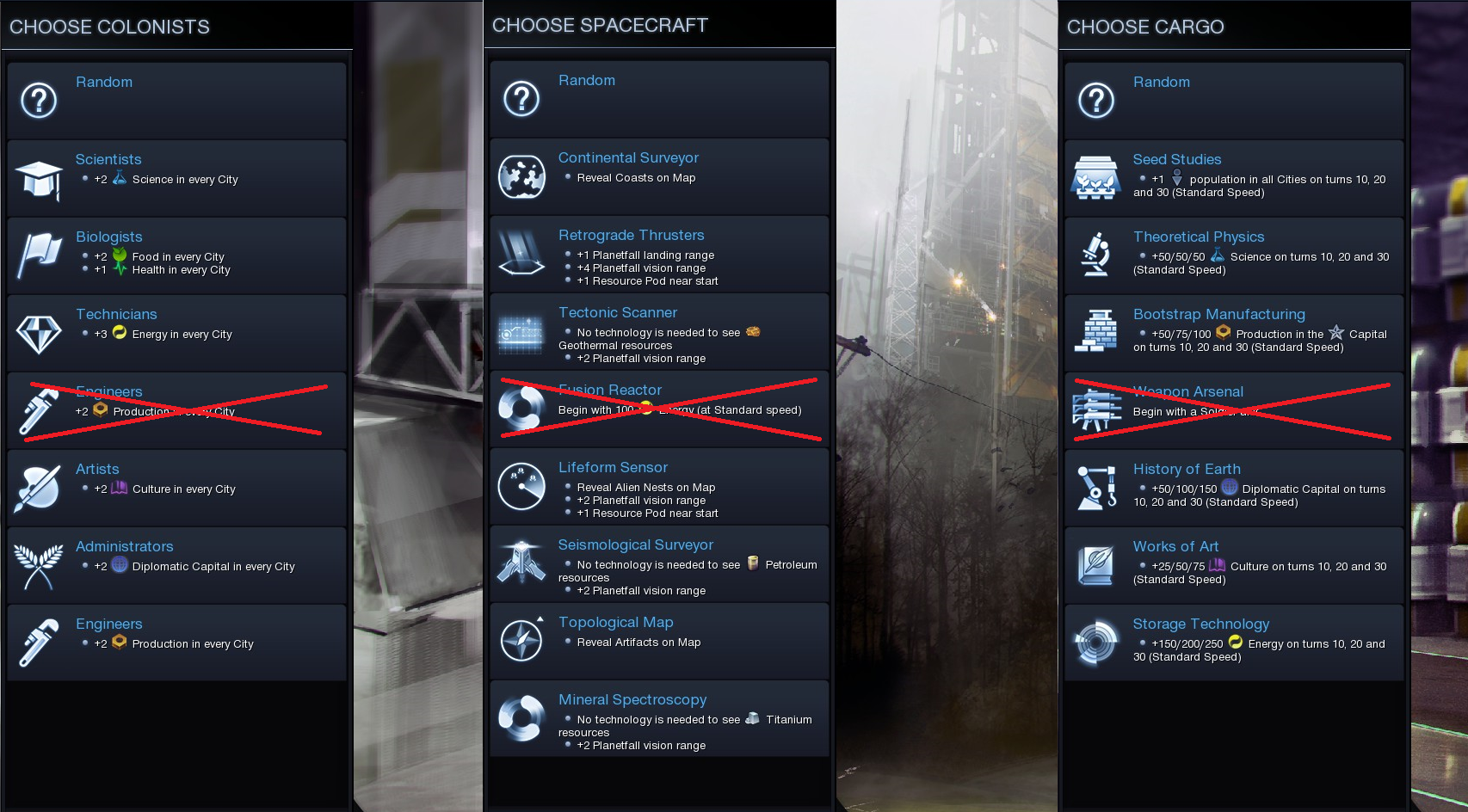
Engineer (the top one), Fusion Reactor and Weaponry are crossed out in the picture due to a known technical limitation. You should not pick those loadouts, as their UI is hard coded. If you pick them you will be given a different loadout instead.
Faction Traits
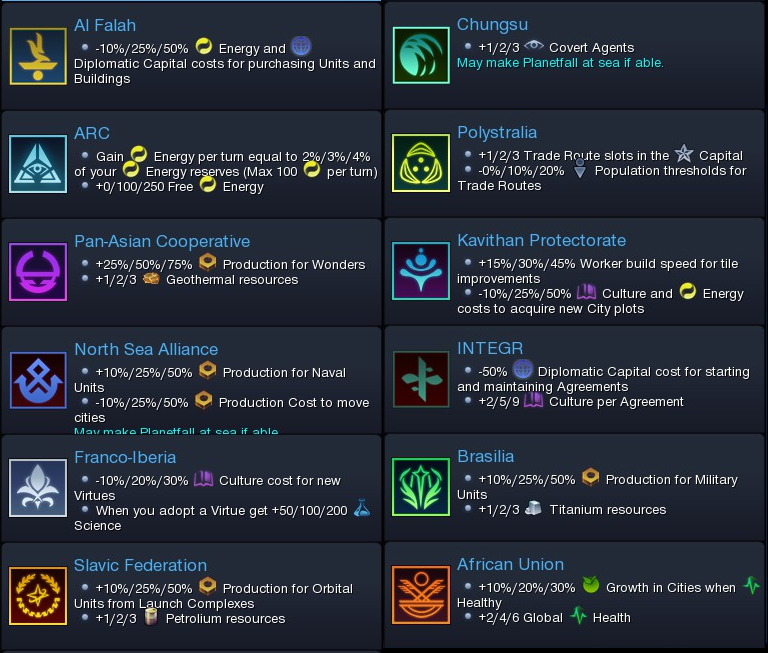 Brasilia, Slavic Federation and Pan-Asian Cooperative all play into the new identity of each of the Strategic Resources. Titanium for Military Units, Oil for Orbital Units and Geothermal for Wonders.
ARC can generate a large amount of Energy, but only if you manage your economy well. It won’t save you if you over expand before you are ready.
Chungsu can get multiple spies online before most Colonies will have their Spy Agency complete. Starting in the water will also make it easier to journey across the oceans to make contact with Colonies that landed on the opposite side of the world.
African Union also highlights the new Health system in Echoes of Earth. Because each population consumes more Health than local Health can counteract, Africa’s extra Global Health can enable a player to rapidly expand in the early game or grow much taller than their normal Global Health could support.
Franco-Iberia is not just a Culture Sponsor, she is also a Science Sponsor. If you combine her with Artists and other early Culture sources you can get your first Virtue in a dozen turns and use the free Science to rush out your first technology -- helping shave ten turns off starting your first Settler or Explorer.
Kavithan Protectorate’s ability may not look especially strong, but in Echoes of Earth Culture is much rarer and natural border growth will not always keep up with the needs of your cities. Her ability can save your cities from needing to build marginal defensive buildings just to get extra tiles for your citizens to work. Tile improvements generally take longer in Echoes of Earth as well so saving 3 turns off each Farm or Academy adds up over the course of the game.
Polystralia takes advantage of the new Trade Route system. Cities that haven’t built a Trade Depot get bonus Food or Production for every Domestic Trade Route sent to them. Most Sponsors can’t take advantage of this in more than half their cities because they don’t have the Trade Route slots. The bonus to Trade Routes in Polystralia’s capital allows it to provide for four or more cities single-handedly.
Virtues
 All of the Virtues are different in Echoes of Earth. When you adopt a Virtue you get a one-time boost of Affinity points. Generating Culture is a main way to progress your Affinity during the early stages of the game. You also have a choice between three opening Virtues within each tree. So every game where you open the Purity tree will not be the same.
The depth synergy bonuses all provide a source of Global Health. The final synergy bonus gives you Affinity points when you adopt other Virtues, allowing you to continue to progress your chosen Affinity even when grabbing Virtues in other trees.




Diplomatic Traits
All Diplomatic Traits do different things at each level. At the 2nd level every trait provides a way to get Affinity points. Each trait category (Domestic, Orbital and Military) has 9 traits in total, 3 traits associated with each Affinity.
Traits provide specialized bonuses that will depend on your colony's terrain and strategy. You can max a trait to take advantage of its powerful level 3 capstone ability. Or you could focus on getting multiple traits to level 2 to get the most Affinity points possible. Or you may opportunistically grab a level 1 trait of the "wrong" Affinity type because you need the level 1 benefit. Once the need has passed you can swap the trait to a different one that matches your Affinity.
 Domestic Traits focus on boosting specific tiles within your colony. Domestic Traits provide Affinity when you settle next to specific resources or terrain features. To maximize the impact of your trait you should pay close attention to what your current and future territoriality looks like.
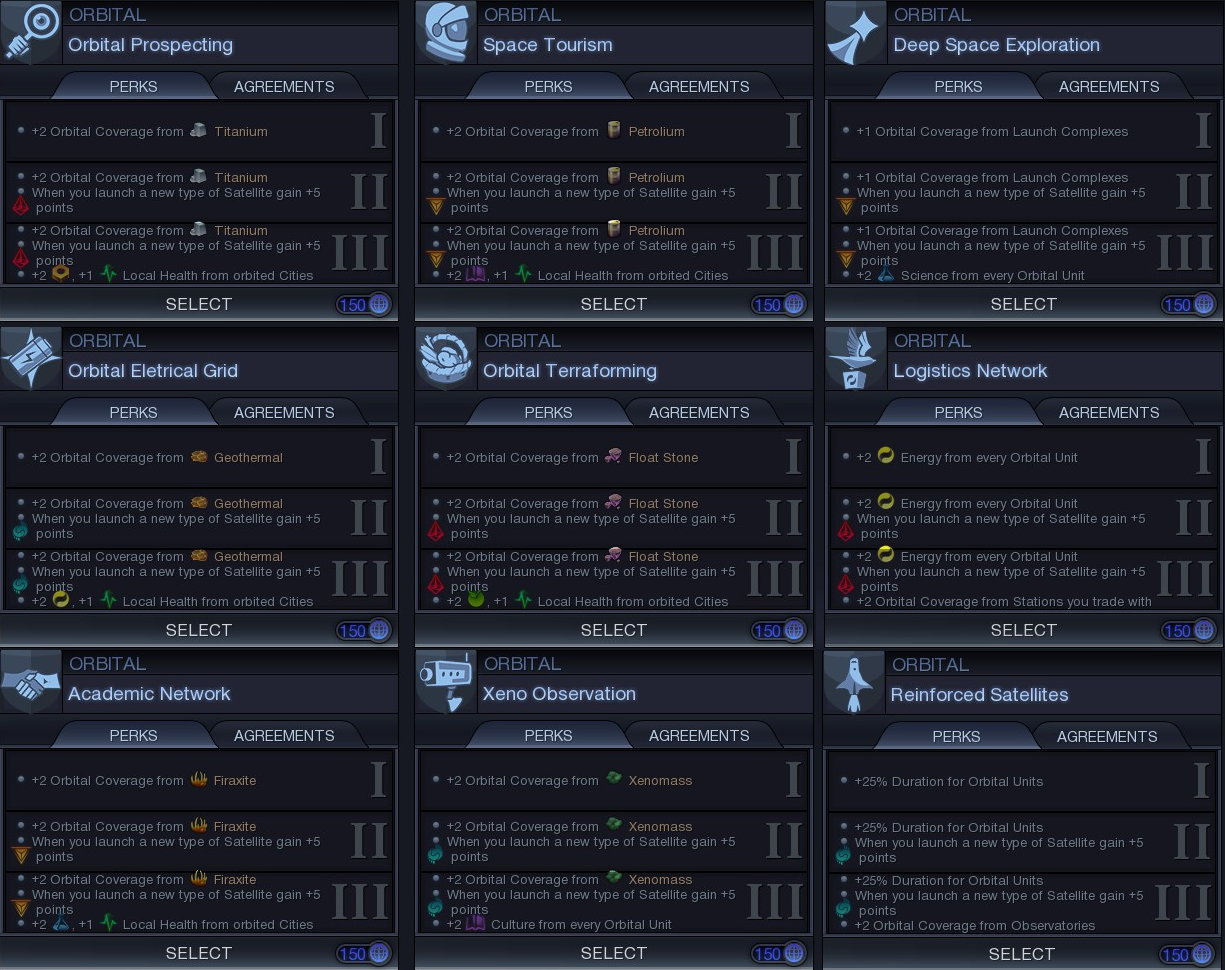 Orbital Coverage is much harder to get in Echoes of Earth but Orbital Traits provide an efficient way to expand your coverage. As you launch new and more advanced types of satellites your Orbital Trait will provide you Affinity points. When combined with the Science satellites automatically generate from the Signal, early satellites can provide a strong source of Science in the early game.
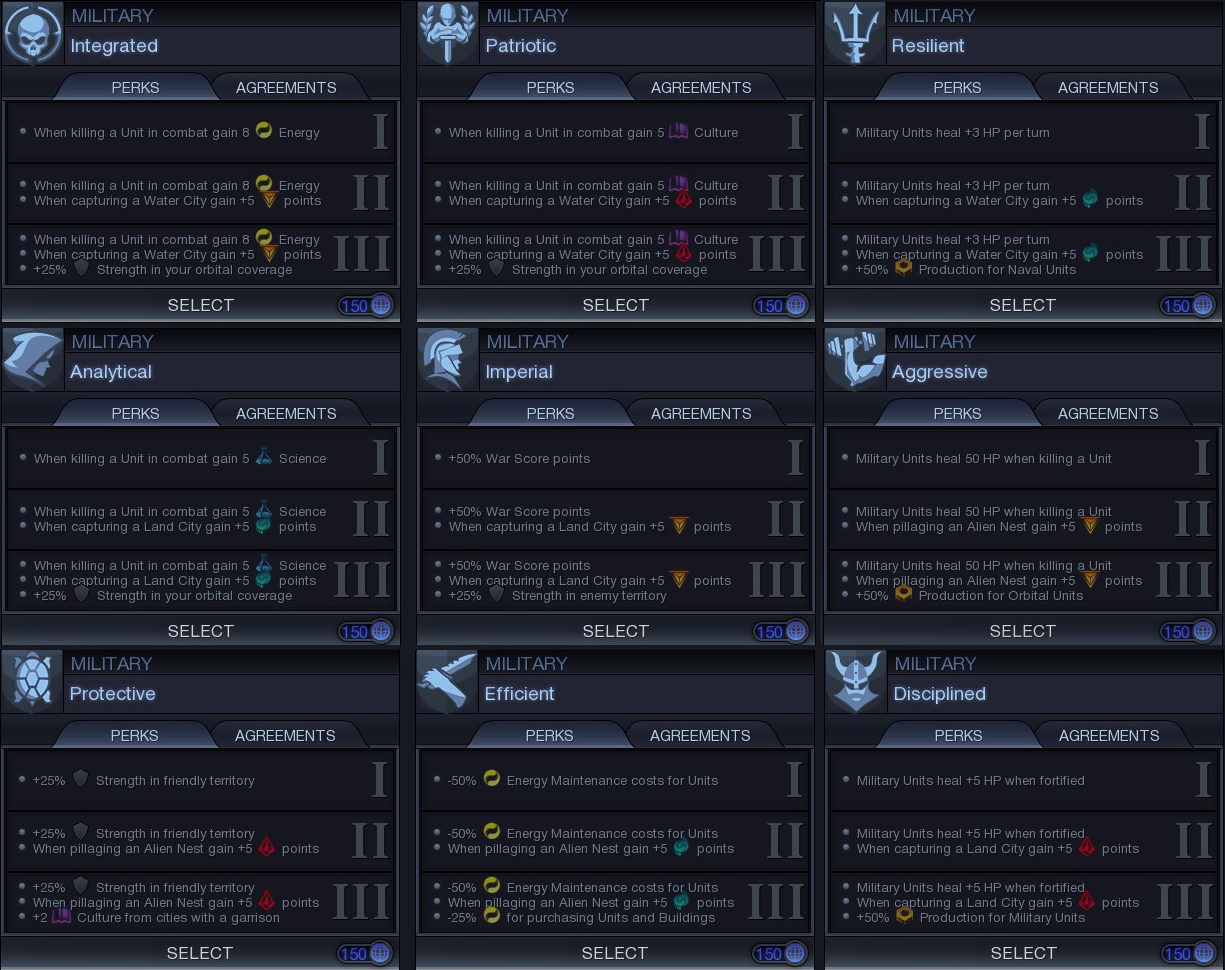 Military Traits can do more than just provide combat bonuses — although they do do that. They can also provide Affinity points when you capture enemy cities or pillage Alien Nests. Even if you don't intend to conquer the new world there are traits that will help you protect your own colony from more bloodthirsty rivals.
Agreements
Affinity Perks
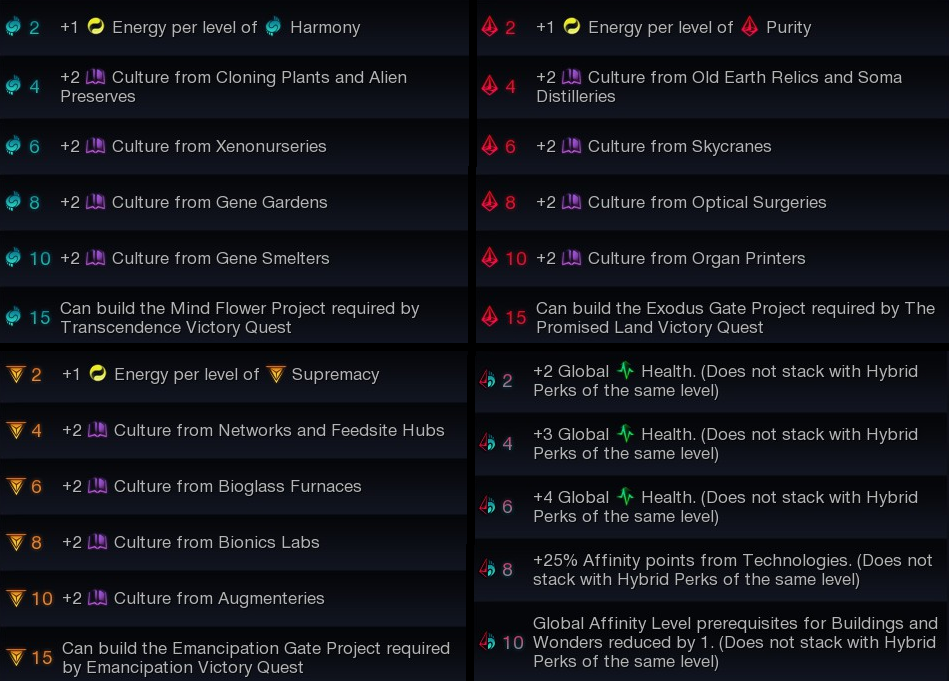
Specialists
- Grower: +3 Food, +1 Diplomatic Capital
- Engineer: +3 Production, +1 Diplomatic Capital
- Technician: +3 Energy, +1 Diplomatic Capital
- Scientist: +2 Science, +2 Diplomatic Capital
- Artists: +2 Culture, +2 Diplomatic Capital
Health System
A core part of the new Health system is the difference between "Local Health" and "Global Health". Local Health is associated with a specific city, and a city can not produce more local Health than its population. Global Health, on the other hand, is not tied to a specific city. Rather, it is associated with the player or colony as a whole.
Cities can generate Local Health through buildings (such as Clinics), by working certain tile improvements or resources (such as Biowells), or by working tiles under the effect of a Paean Satellite.
Most sources of Global Health explicitly refer to themselves as global rather than local. Every player starts with a certain amount of Global Health depending on the difficulty level. More Global Health can be accumulated by unlocking synergy bonuses on the Virtue tree, completing quests for Health buildings, and getting Alien artifact rewards.
In Echoes of Earth, keeping your colony Healthy will require careful management of population, Local Health, and Global Health. Expansion is easier, as Cities cost much less unhealth. But populations much be watched carefully as every citizen costs more than 1 unhealth. Local Health is never enough to make a city health neutral, and the more population you have the more sources of Global Health you need to avoid penalties. If you’re diligent about keeping your local Health sufficient for your cities, you can make your starting Global Health last a long time.
Some tile improvements, like the Science boosting Academy, cost unhealth when worked. If you have a city working large numbers of these kinds of improvements, extra investment in local Health infrastructure will be critical even if the city population remains modest.
- 1 Unhealth per city
- 2 Unhealth per captured city
- 1.2 Unhealth per citizen in city (including captured cities)
- Land and Water cities have the same unhealth costs
- Completing quests for Health buildings
- From bonus Synergy Virtues
- From Diplomatic Traits and Agreements
- From Alien Artifact Rewards (combine Alien Artifacts to unlock)
Trade Route System
Internal and Foreign Trade Route yields are exclusively determined by the buildings in the source and destination city. All of the buildings that improve Strategic and Affinity Resources also provide Energy and Science (respectively) for Foreign Trade Routes. A well positioned city can provide a huge amount of yield by sending its Trade Routes abroad. Cooperating with the other player will increase the bonuses even more.
For Internal Trade Routes, after completing the Trade Depot quest cities that haven't built a Depot of their own will get extra food or production from Internal Trade Routes sent to them. This allows a young city to expand rapidly. You may also decide to delay building Depots in some of your cities to maximize the amount of yield they get from Trade Routes your other cities send them.
- Everyone starts with a +100% yield from Internal and Foreign Trade Routes (this is why a building that says +1 Food from Trade Routes will actually provide +2)
- Cooperating or Allying will increase the International Trade Route yield multiplier from +100 to +200 (resulting in building that says +1 Energy providing +3 Energy)
Energy Economy and Maintenance
Many sources and uses for Energy have changed. Now, roads are not the only tile improvements that cost Energy to maintain -- making the biggest limit to going wide Energy rather than Health. Over expansion is now more likely to result in tile maintenance tanking your Energy economy than your Health. Advanced improvements available in the mid-game, like Arrays and Terrascapes, cost even more energy to maintain but can push your economy even farther.
Unit maintenance is now calculated differently as well. Basic Marines and Patrol Boats are free to maintain, making them ideal units to garrison your cities with. More advanced units, like tanks, artillery and jets cost one or more energy per turn to maintain, so be careful about building a large army unless you plan to use it quickly.
Generating Energy can be done with Generator improvements, Trader specialists and certain resources. If you find yourself struggling to produce enough energy to meet your colony's needs, and there is terrain with plenty of Geothermal, expanding to grab that resource could help counteract your deficit.
Wonders
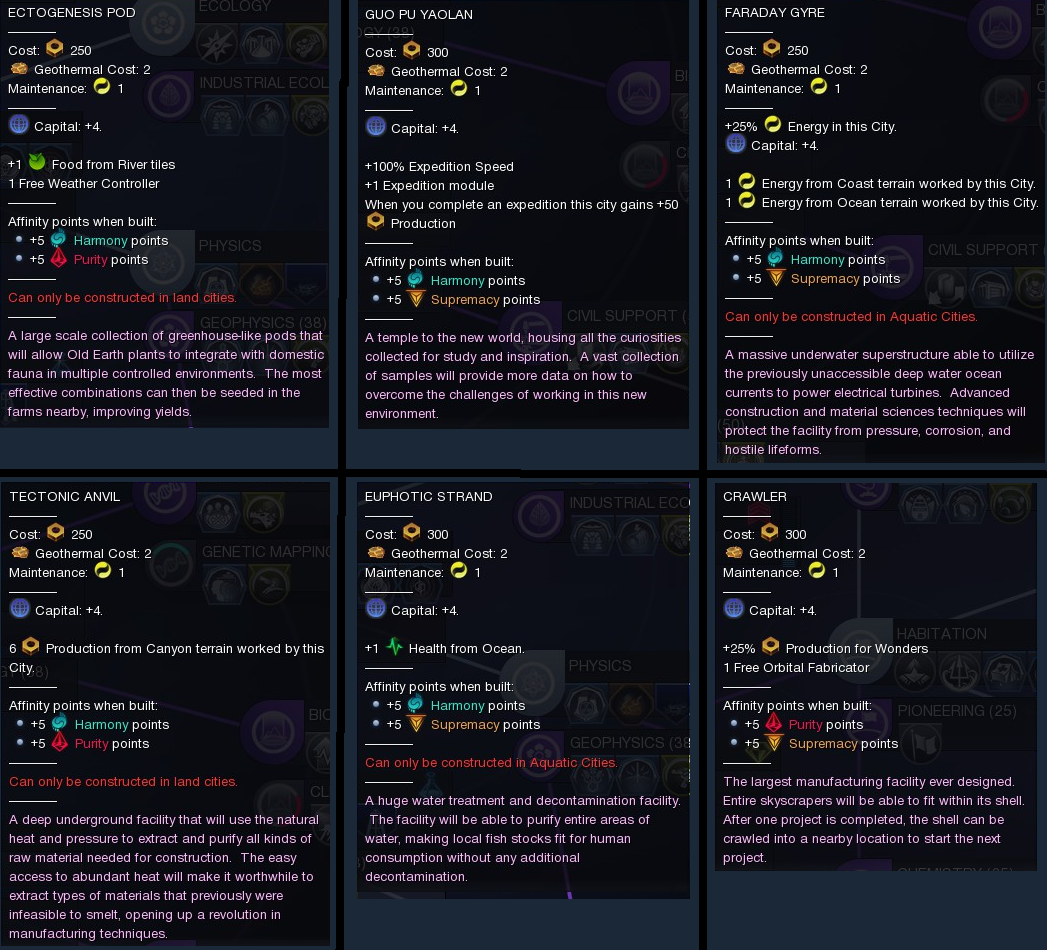
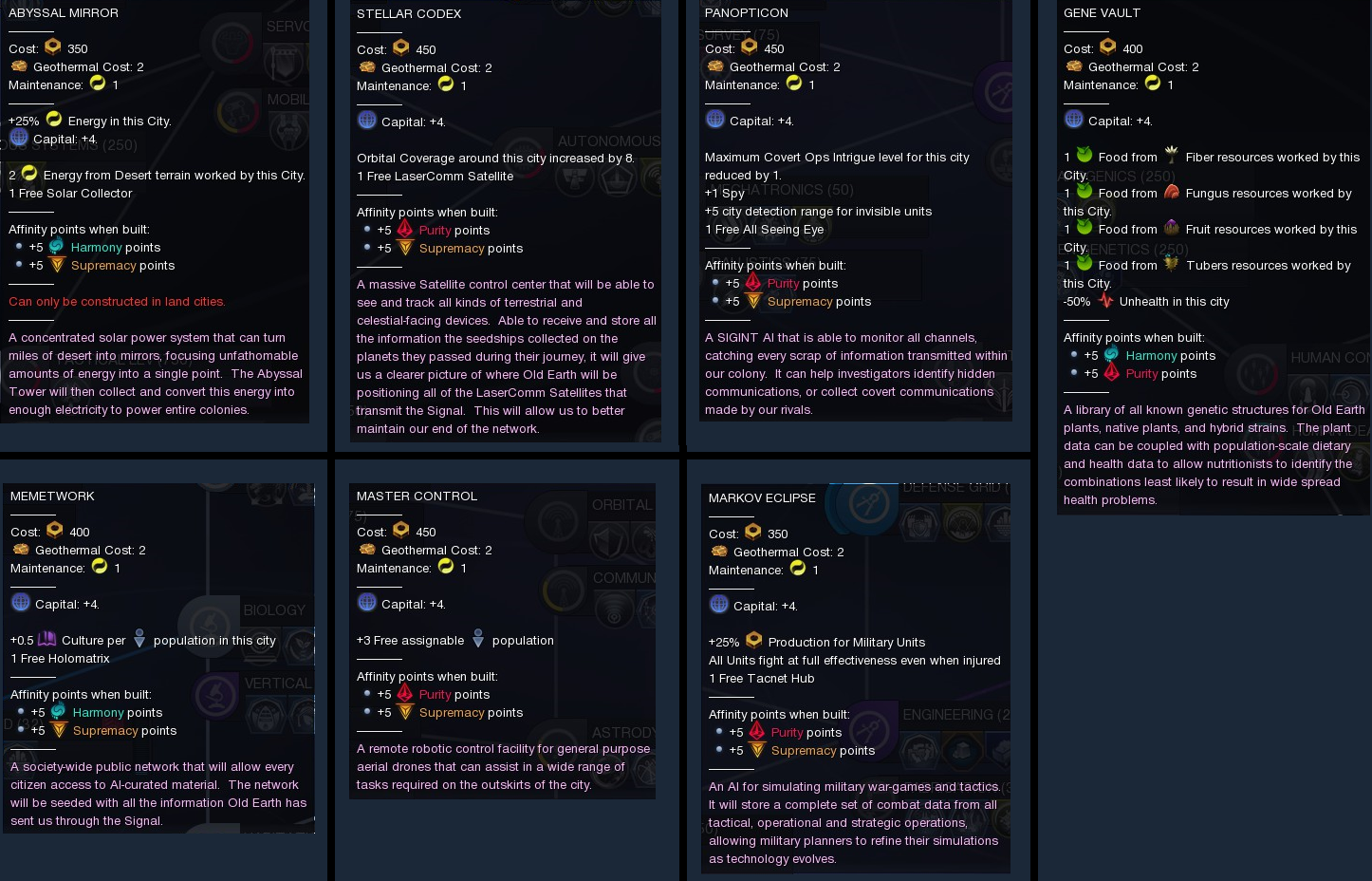
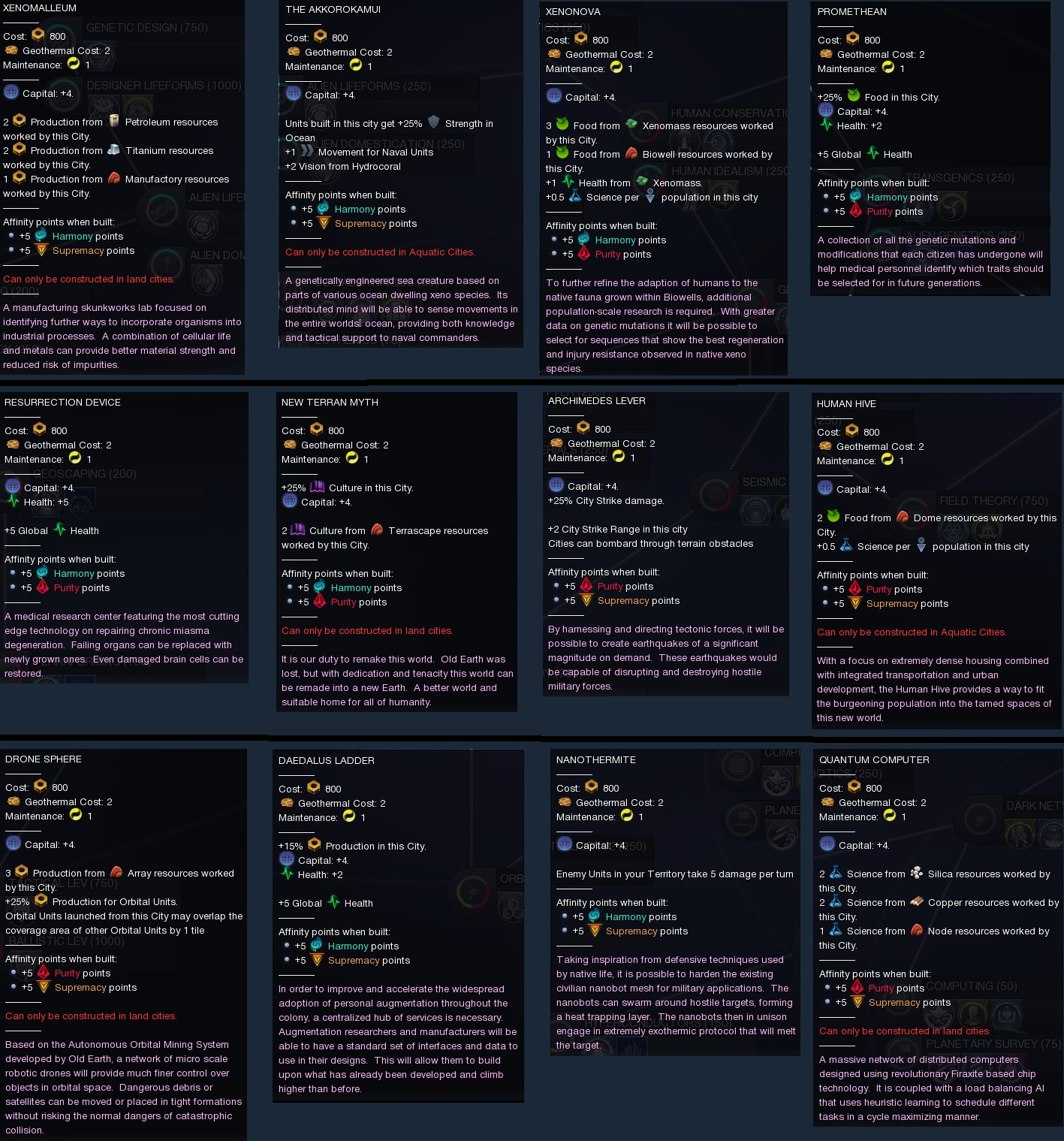
Wonders in Echoes of Earth have three core properties:
- Wonders require Geothermal Resources to build
- Wonders provide one-time Affinity points when built
- Wonders depend on the qualities of the city
Buildings
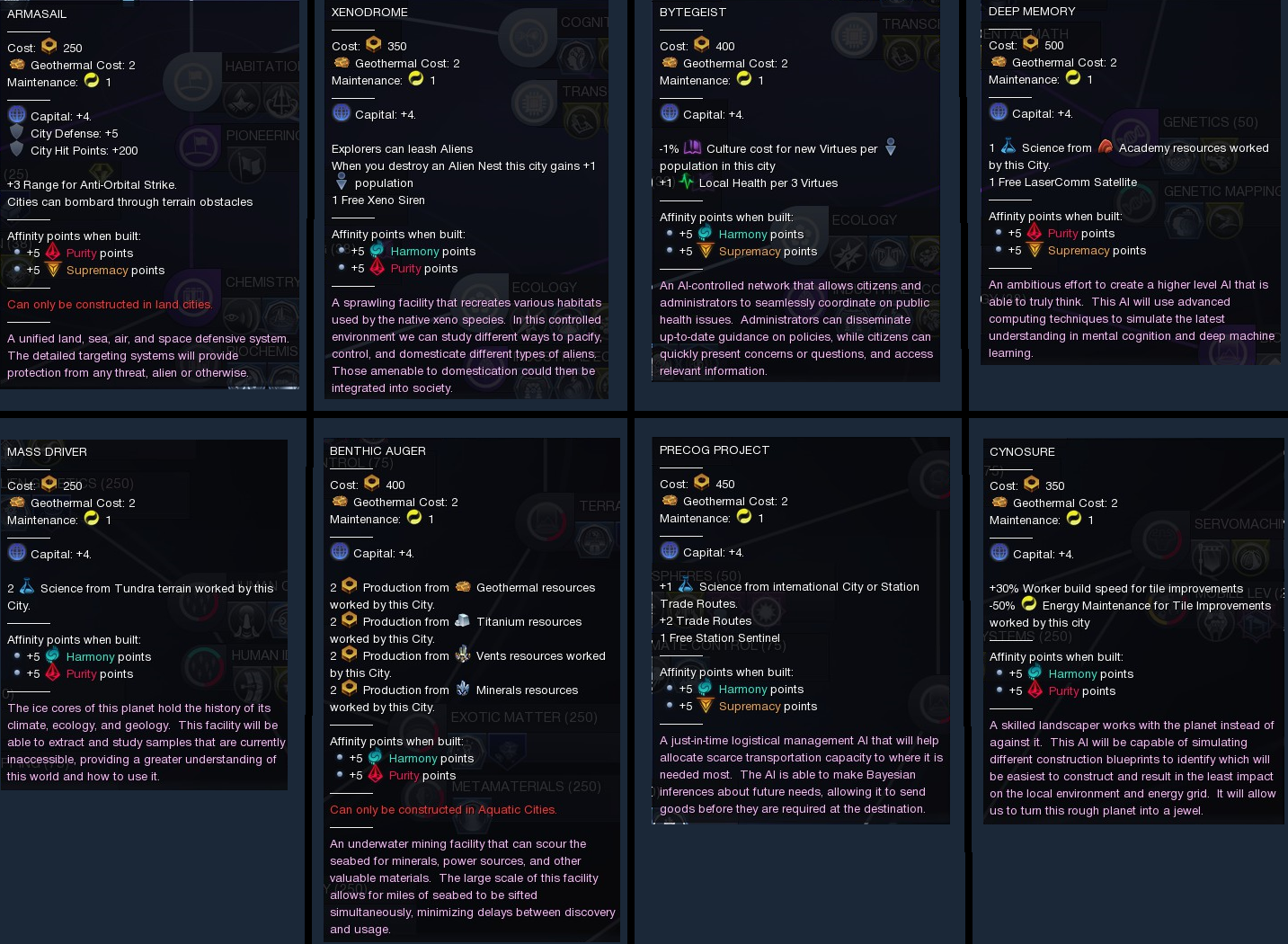
Every building has been changed in Echoes of Earth, forming a unique and distinct economic skeleton. Many buildings, especially early game buildings, are highly dependent on what terrain and resources are around your cities. In the early game there are a collection of buildings that provide two specialist slots. These buildings can be useful for generating a basic amount of food or production if a city is lacking in those areas. But while those buildings may help compensate for a city's weaknesses, they won't be enough to turn a production poor city into a Wonder powerhouse.
In the late game, your building choices will depend on what Affinity your colony is developing along. Each Affinity has a unique set of buildings that incorporate distinct styles of play.
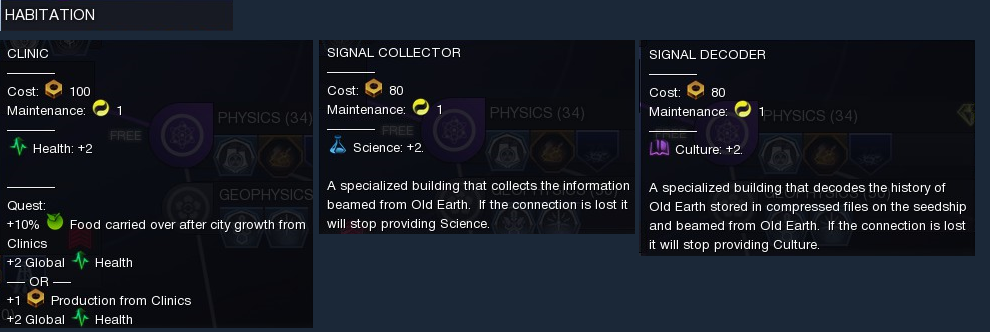 Generating Culture in the early game is harder in Echoes of Earth. Old Earth Relic does something completely different from the base game and the closest substitute are Signal Decoders. The Decoders won't last forever, but cities founded later won't need as much production to build them.
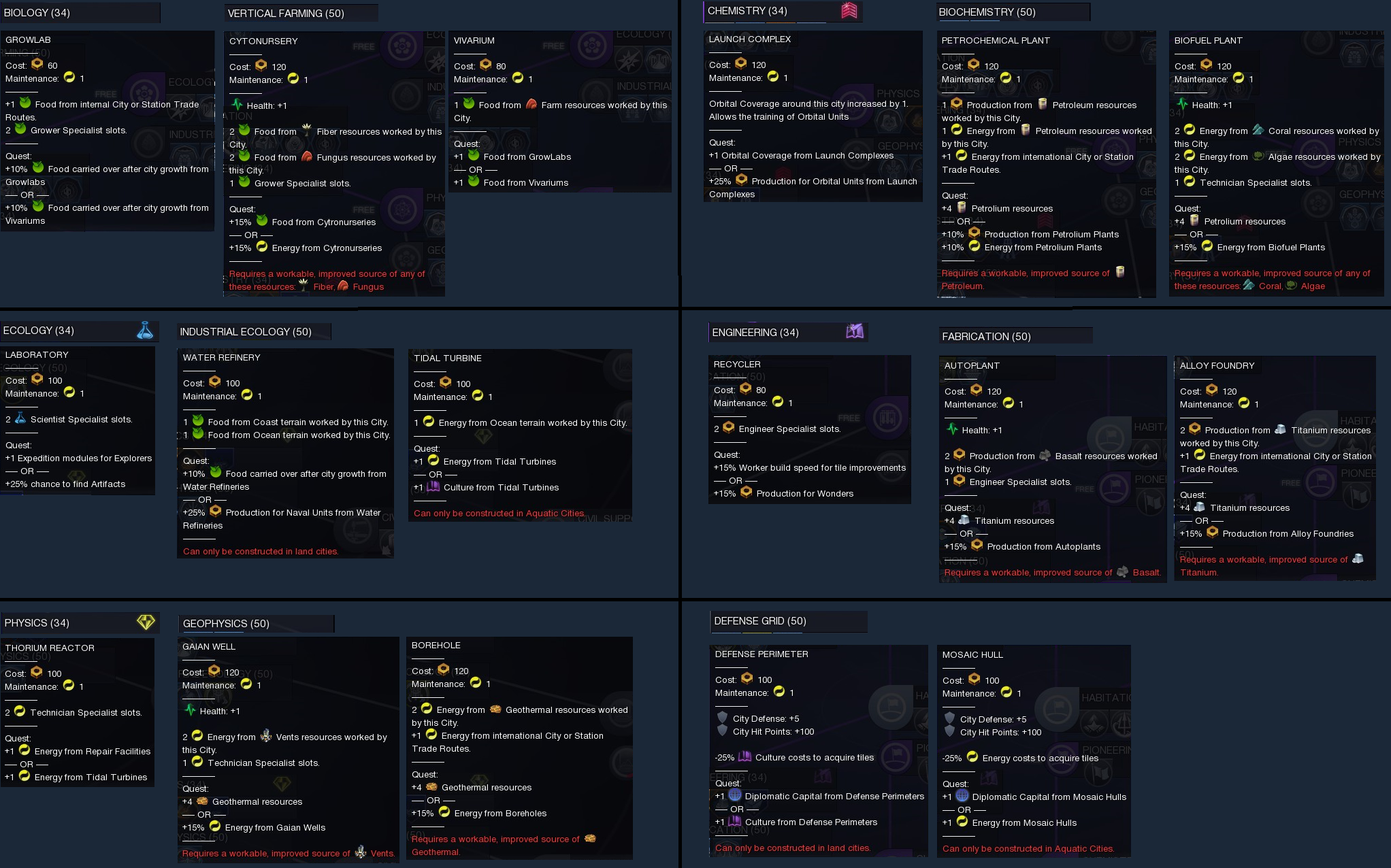 These buildings provide access and bonuses for the Strategic Resources. If your colony has plentiful access to Oil the Petrochemical Plant can provide a significant boost. But if you only have a single source of Oil consider taking the quest that gives you extra Resources. The 4 extra units will give you more breathing room to meet your colony's needs.
Other buildings, like the Farm-boosting Vivarium and the Growlab, provide the basic sources of Food. Growlabs are cheap and best built in cities that don't have the terrain required for Farms. Which quest you take will depend on how much of your colony looks like it will be using Farms verse Growlabs.
There are also buildings that provide basic sources of Science and city defense. Depending on your quest choices the city defense buildings can serve as your basic sources of Culture or Diplomatic Capital.
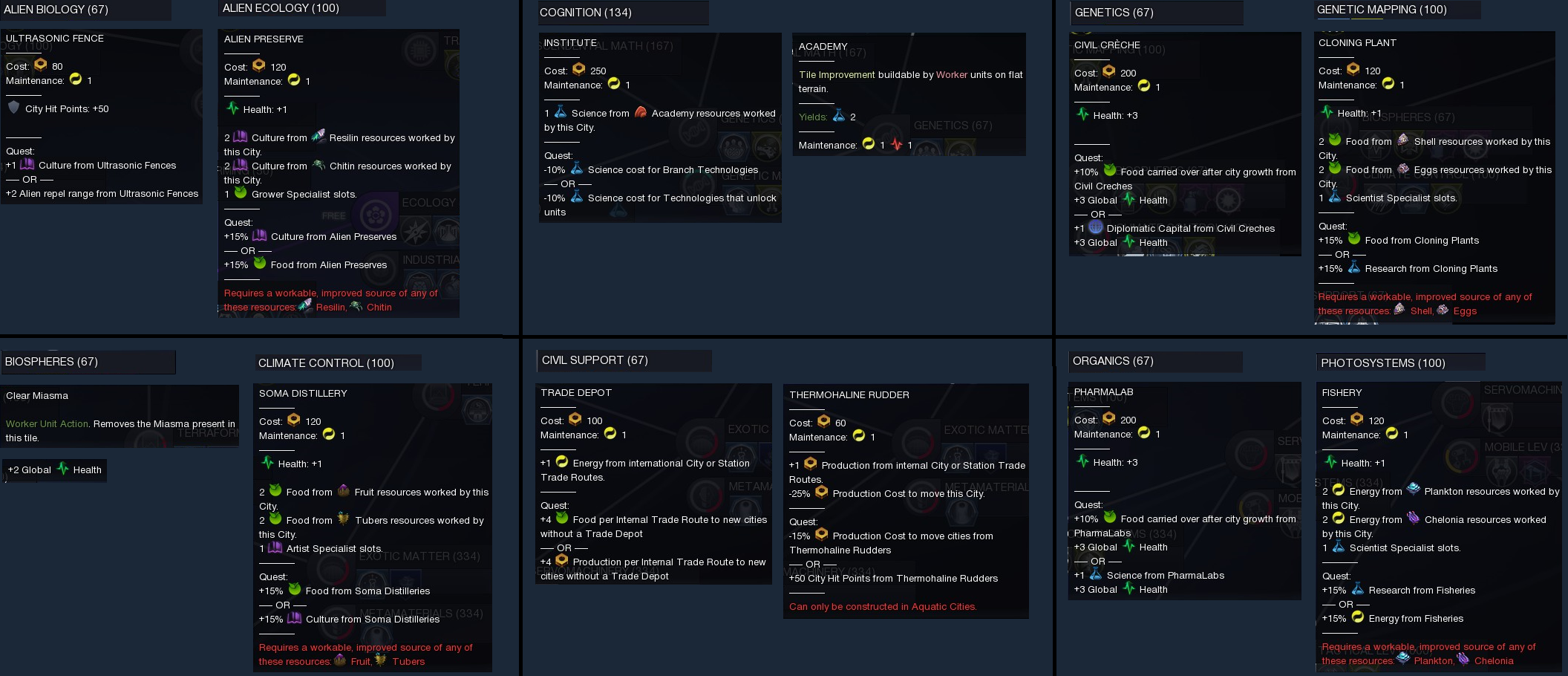
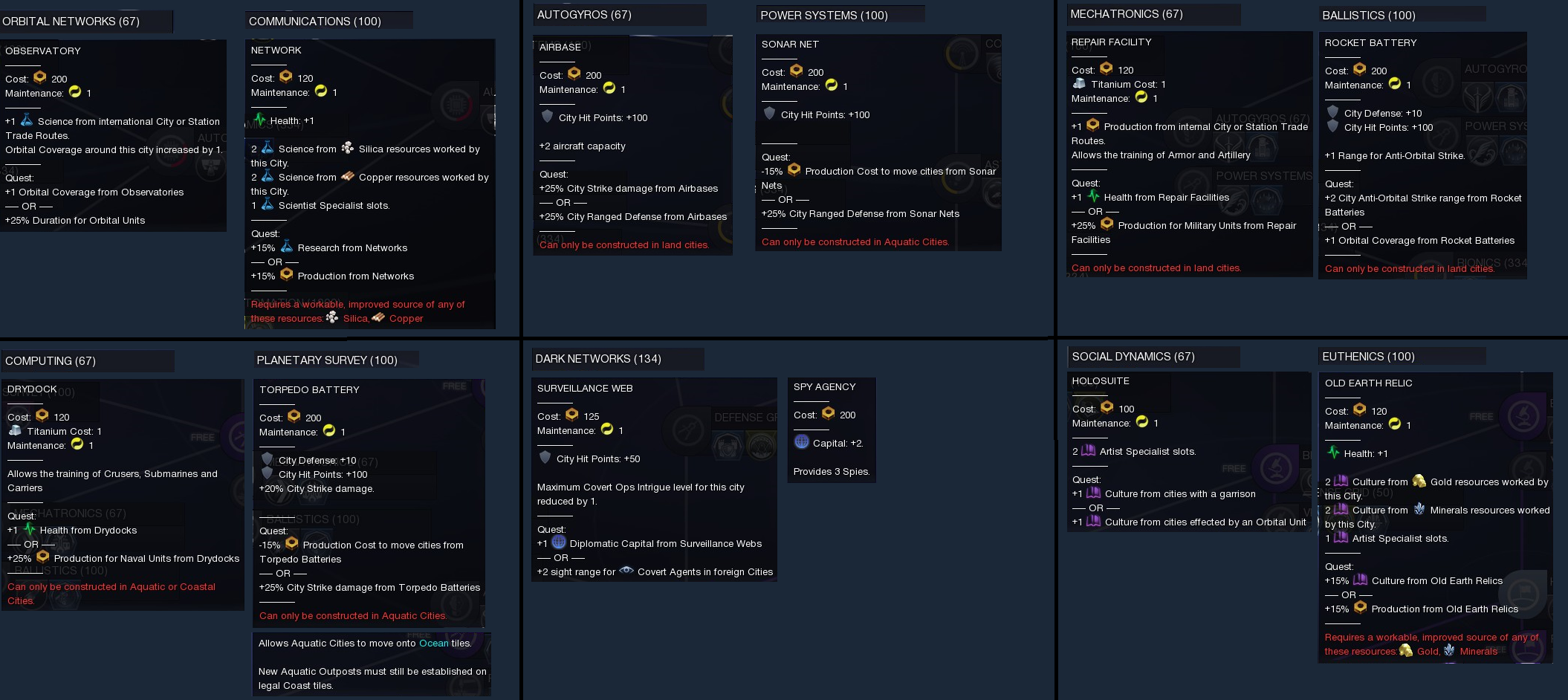 Many of the Ring 2 leaf techs grant access to buildings that boost specific Basic Resources. These buildings can be extremely powerful if your colony has access to a large number of the correct type of Resources. To help remember which pair of Basic Resources are enhanced by a building, the Basic Resources always share the same Improvement. For example, the Alien Preserve enhances Resilin and Chitin, both of which use the Paddock Improvement.
There are three main Science generators available in the mid game:
Many of the Ring 2 leaf techs grant access to buildings that boost specific Basic Resources. These buildings can be extremely powerful if your colony has access to a large number of the correct type of Resources. To help remember which pair of Basic Resources are enhanced by a building, the Basic Resources always share the same Improvement. For example, the Alien Preserve enhances Resilin and Chitin, both of which use the Paddock Improvement.
There are three main Science generators available in the mid game:- LaserComm Satellites, which enhance the Signal and provide +50% Science in covered cities
- Spy Agency, to steal Science and Technologies from other players
- Academies, which provide large amounts of Science but require a good Health infrastructure backing them up
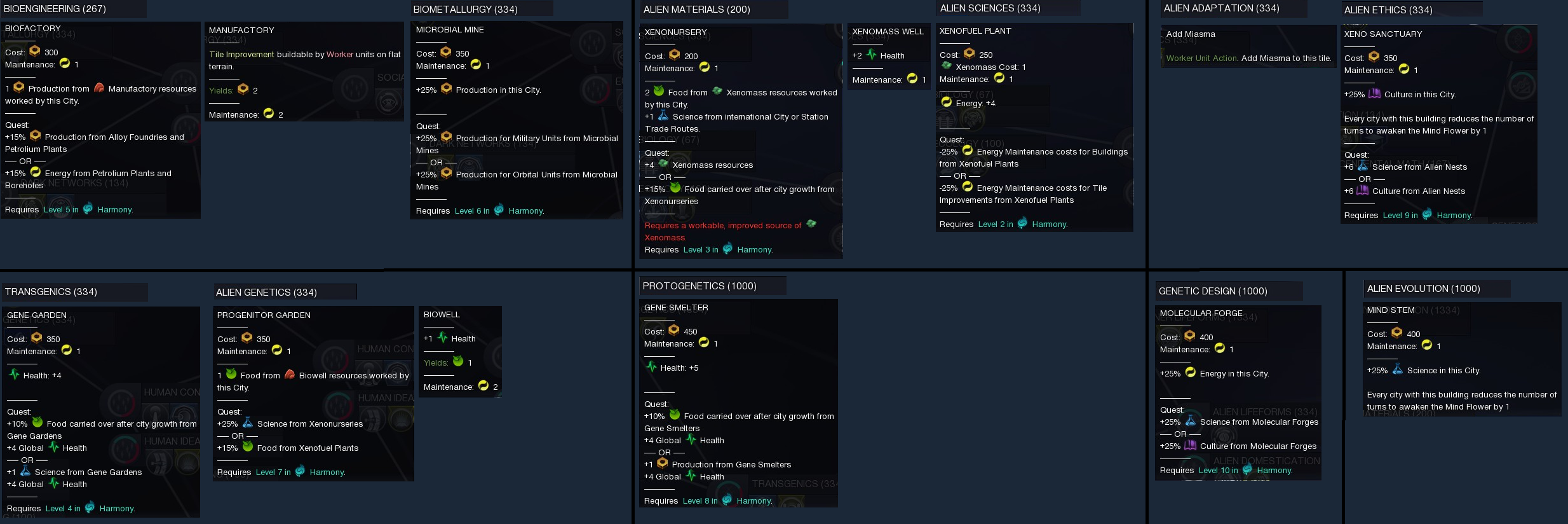 Harmony buildings reflect the Affinity's desire to take full advantage of possibilities created by genetic engineering and biological manufacturing. By studying and learning from all of the lifeforms on the new world, they can even use the Xeno Sanctuary to generate Science or Culture from Alien Nests in their territory.
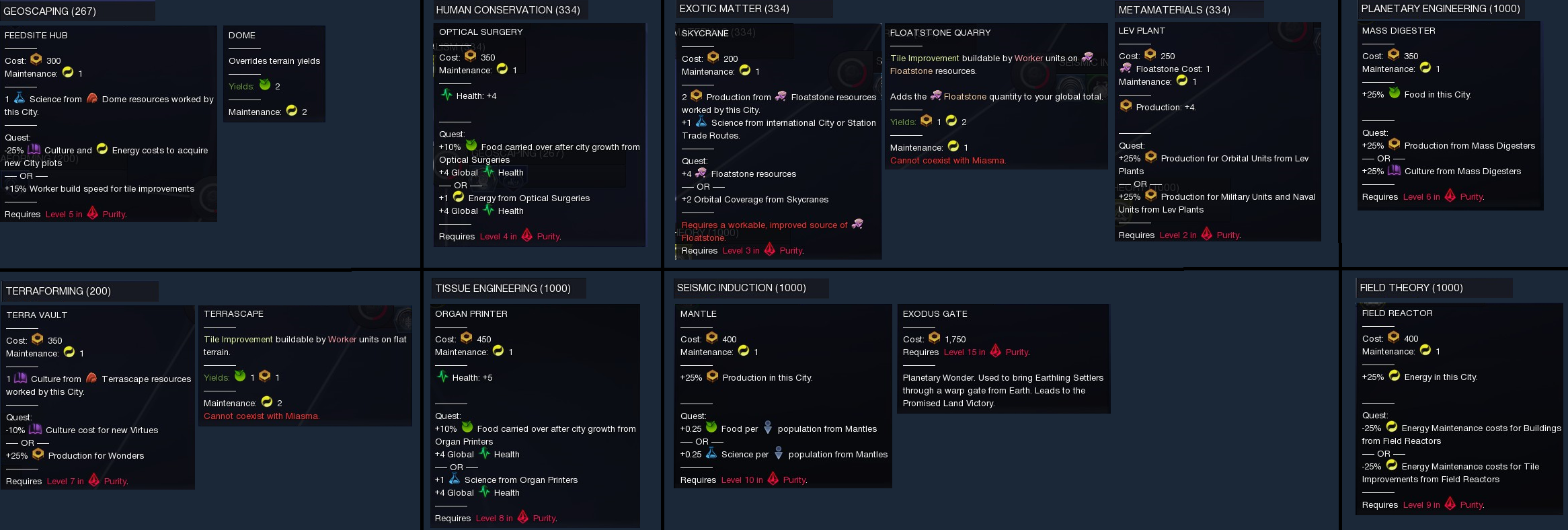 Purity focuses on changing the world as a whole to be more comfortable for humans. As it learns more about the geological and tectonic forces, it develops new ways to harness them to achieve its ends. This mission is coupled with the best medical and surgical techniques to repair the damage that is caused by life on the world.
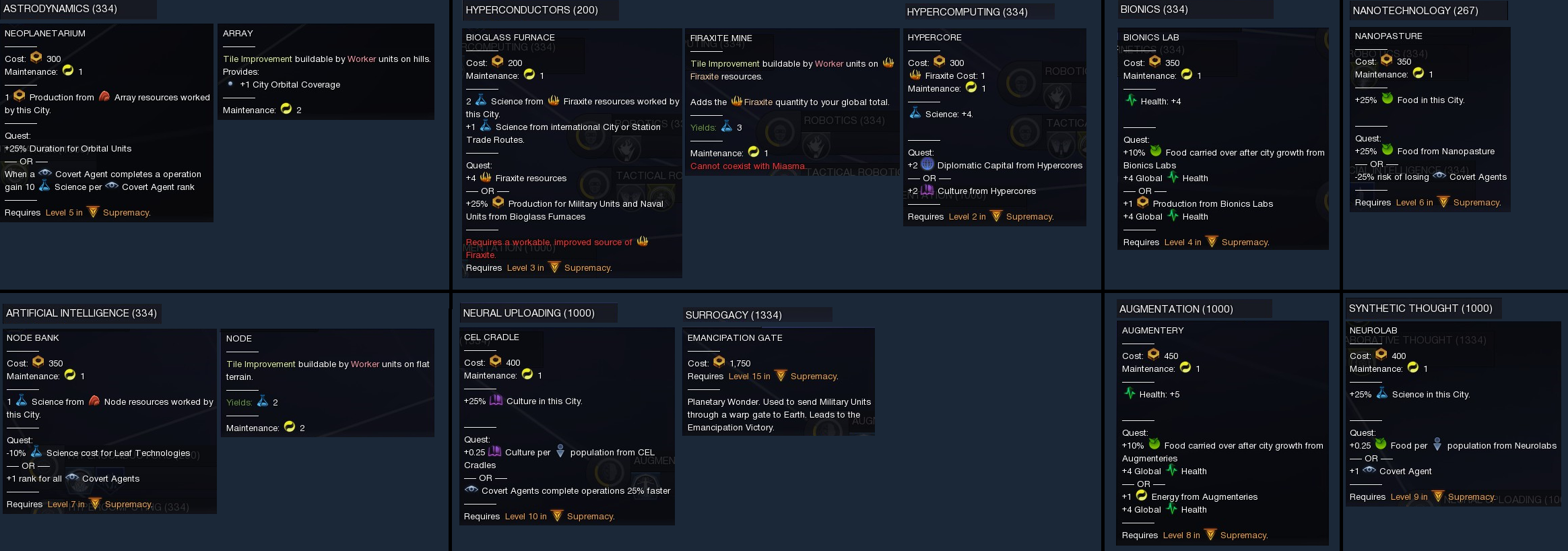 Many Supremacy buildings boost Satellites and Spies. The Satellite boost comes from Supremacy's technological inclinations helping them to overcome the engineering challenges demanded by spaceflight. Spies are boosted because it is much easier to track individuals when every action is part of a measurable computer system.
Terrain
In the mid game, advanced improvements become available that -- depending on your Affinity and technology choices -- can allow you to generate food in locations that were previously barren. This can allow a wave of expansion as new parts of the planet become hospitable to your colony.
These terrain bonuses stack with improvements that override base yields -- so Coastal cities can get 3 Food from Domes built on Coastal tiles, and Water cities can get 2 Food and 1 Production from Domes built on Coastal tiles.
Most advanced improvements can't be built on water tiles. Other than Domes, only Farms can be built on Coastal water tiles, and only Generators can be built on Ocean tiles. This means that Water cities are more dependent on having lots of resources nearby rather than lots of empty tiles with improvements. The extra yield from Water Refineries or Tidal Turbines will also enhance these resource tiles, making resources on water tiles one of the strongest tiles possible.
Resources
Each of the Strategic Resources in Echoes of Earth has a unique role and identity.
- Xenomass Wells: +2 Health (+2 Food with Xenonursery)
- Float Stone Quarry: +1 Production, +2 Energy (+2 Production with Skycrane)
- Firaxite Mine: +3 Science (+2 Science with Bioglass Furnace)
Improvements
Improvements can cost Energy and/or unhealth to maintain. The Energy cost is paid no matter what, but a city only suffers the unhealth cost if it is working the tile. While non-resource Mines and Generators don't cost Energy to maintain, Farms do. Avoid building unnecessary Farms or else you will needlessly tax your Energy economy.
Advanced improvements (like the Array or Dome) are more powerful but often cost more energy to maintain. Each Affinity is associated with two advanced improvements. Harmony has Manufacturies and Biowells, Purity has Domes and Terrascapes, while Supremacy has Arrays and Nodes.
Other than mines and generators, each Improvement has a building which enhances its yield. If a city is working a large number of Farms, a Vivarium will help it grow even faster. If a Science city is working a large number of Academies, an Institute will increase its Science even more. Diplomatic Traits provide another means of further enhancing the yields provided by various improvements.
- Farm:
- Yield: +1 Food (+1 Food with Vivariums)
- Requirements: River or Coastal Water
- Maintenance: 1 Energy
- Yield: +1 Food (+1 Food with Vivariums)
- Mine:
- Yield: +2 Production
- Requirements: Hills
- Maintenance: 1 Unhealth
- Yield: +2 Production
- Generator:
- Yield: +1 Energy
- Not an impressive improvement but one of the few that can be built on Ocean tiles.
- Yield: +1 Energy
- Academy:
- Yield: +2 Science (+1 Science with Institute)
- Requirements: Flat land
- Maintenance: 1 Energy and 1 Unhealth
- Expensive but able to generate lots of Science.
- Yield: +2 Science (+1 Science with Institute)
- Manufacturies:
- Yield: +2 Production (+1 Production with Biofactory)
- Requirements: Flat land
- Maintenance: 2 Energy
- Associated with Harmony. A good way to get production if a city lacks hills, or you don't want to deal with the unhealth from working mines.
- Yield: +2 Production (+1 Production with Biofactory)
- Biowell:
- Yield: +1 Food, +1 Health (+1 Food with Progenitor Garden)
- Maintenance: 2 Energy
- Associated with Harmony. Similar to a Farm but provides Health and doesn't require a River.
- Yield: +1 Food, +1 Health (+1 Food with Progenitor Garden)
- Dome:
- Yield: +2 Food, but overrides terrain yield (+1 Science with Feedsite Hub)
- Maintenance: 2 Energy
- Associated with Purity. Best built on marginal terrain like desserts or tundra. Is best on water tiles where it can stack with Water Refineries.
- Yield: +2 Food, but overrides terrain yield (+1 Science with Feedsite Hub)
- Terrascape:
- Yield: +1 Food, +1 Production (+1 Culture with TerraVaults)
- Requirements: Flat land
- Maintenance: 2 Energy
- Associated with Purity. A hybrid farm and mine that can be built in places without rivers. The best way to get Culture from an Improvement.
- Yield: +1 Food, +1 Production (+1 Culture with TerraVaults)
- Array:
- Yield: +1 Orbital Coverage (+1 Production with Neoplanetarium)
- Requirements: Hills
- Maintenance: 2 Energy
- Associated with Supremacy. A very cheap way to expand a city's orbital coverage, provided there are hills nearby.
- Yield: +1 Orbital Coverage (+1 Production with Neoplanetarium)
- Node:
- Yield: +2 Science (+1 Science with Node Bank)
- Requirements: Flat land
- Maintenance: 2 Energy
- Associated with Supremacy. An alternative to the Academy. Costs less unhealth to maintain but requires more Energy.
- Yield: +2 Science (+1 Science with Node Bank)
Orbital System
Orbital units are available much earlier in the game and provide large economic bonuses. In the early game, all satellites are able to help collect the Signal, providing as much as +3 Science per turn. As the Signal fades, this bonus decreases. Many satellites provide +50% yield (such as Food or Science) to the city beneath them, making satellites a core way for you to specialize your cities. The Paean's +1 Health to worked tiles is a very effective way to ensure a city working lots of unhealth improvements (such as Academies) to remain healthy.
But satellites are also expensive. Most only last 20 turns, requiring more production to keep them maintained as they age. Satellites also require the strategic resource Oil, which means the amount of Oil you have constrains the number of satellites you can have, even if you have plenty of production. Orbital Coverage is also harder to get. Cities start with only the tile they are on. If you want more, you'll need to invest in infrastructure to expand it.
There are many ways to get production and duration bonuses for satellites. Buildings, technologies, and Diplomatic Traits can all let you stack bonus upon bonus. Grabbing as many of these bonuses as possible is key to enhancing the effectiveness of the production you invest in your satellites.
- Weather Controller: +50% Food in covered cities and can spawn new basic Resources
- Orbital Fabricator: +50% Production in covered cities.
- Useful for cities trying to get their buildings or wonders online faster.
- Solar Collector: +50% Energy in covered cities.
- Ensures your Energy cities will be able to cover the maintenance costs incurred by your other cities.
- LaserComm Satellite: +50% Science in covered cities.
- Can only be built during the first 100 turns when the Signal is active.
- A great source of Science but one that won't work forever.
- Can only be built during the first 100 turns when the Signal is active.
- Deep Space Telescope: +50% Science in covered cities.
- Requires more technology than LaserComm Satellites but can be used throughout the game.
- Holomatrix: +50% Culture in covered cities.
- Culture is rare in Echoes of Earth so if you have a city generating lots of it a Holomatrix will ensure you can continue to afford new Virtues even into the mid game.
- Paean: +1 Local Health in cities that work covered tiles
- Useful for cities with very high populations.
- Great for cities working lots of improvements that cost unhealth (like Academies or Mines)
- Useful for cities with very high populations.
Artifact Rewards and Expeditions
- Wonders in the Techtree★ 5 (352)25k views368 ♥1 minUpdated Oct 29, 2014
- How to boost your FPS and remove input lag (Beyond 60FPS)★ 5 (219)18k views288 ♥3 minUpdated Oct 28, 2014
- Unlock extra starting options and maps for Beyond Earth (official Starships bonuses)★ 4 (96)15k views151 ♥1 minUpdated Oct 9, 2015
- Beyond Earth Achievement Guide★ 5 (306)14k views454 ♥14 minUpdated Dec 31, 2014
- Become the Neighborhood Bully★ 4 (149)13k views179 ♥6 minUpdated Nov 1, 2014
- Unit and Affinity Guide★ 4 (92)12k views101 ♥11 minUpdated Dec 9, 2014




- Upgrading to PremiumTeam Fortress 2★ 5 (20k)1441k views11k ♥6 minUpdated May 11, 2022
- No More Room in Hell Official ManualNo More Room in Hell★ 5 (2.8k)569k views2.1k ♥29 minUpdated Apr 22, 2019
- NMRiH Community Hosting GuidesNo More Room in Hell★ 5 (526)351k views653 ♥1 minUpdated Aug 10, 2022
- ULTIMATE GUIDE FOR GAME DEV TYCOONGame Dev Tycoon★ 5 (5.8k)326k views10k ♥4 minUpdated 23 Jan, 2014
- How to 'Git Gud' Soon™MORDHAU★ 5 (2k)318k views3k ♥68 minUpdated Nov 16, 2024
- Лучшие кооперативные игры SteamPAYDAY 2★ 5 (1.5k)315k views2.1k ♥56 minRussianUpdated Apr 27, 2025






This guide was created by its original author on the Steam Community. Are you the author and want it removed? Request removal.