Napoleon Total War - Naval Unit Guide
Introduction
The strategic context has more impact on naval battles than it does on land battles and this will be explored briefly in the guide.
The Role of the Navy
In the game, armies exist to capture and defend provinces which are the core to a faction's existence. Fleets cannot gain territory, so their role is more strategic in terms of supporting the overall position of a faction. With only a European theatre and many trade nodes on the same map, Great Britain, France and Spain start off as major naval powers. Over the course of the campaign Russia, Prussia and Austria may make use of fleets more but have roster deficiencies. Broadly speaking, there are five roles that fleets need to fill in the game.
Trade routes provide opportunities to inflict financial loss on enemies and gain for yourself. As the trade routes exist within the one theatre, raiders are more easily caught so forces may need to be larger than individual ships. Frigates provide more return from raiding than ships of the line, and groups of ships add more than individual units so two frigates in one group will bring in more than two operating separately. As a result, frigates are a far better investment for raiding than larger ships, and this gives a reason for the recruitment of smaller frigates like the 24-Gun/Corvettes.
If an enemy faction is earning strongly from trade, then it will be due to their trade ships on trading posts. These fleets are juicy targets in wartime, and their defeat not only sets your opponent back in earnings but will net decent prize money. Small fleets of fast, powerful vessels are good for this role as most merchant vessels are poorly armed. Spain, Portugal and Great Britain are very close to many trading posts and therefore can exert control over these. Some nations can build well-armed Indiamen which will stand up to frigates.
Blockading a trade port prevent all trade through the port so it can impact an enemy nations economy heavily. However, unlike commerce raiding, no income is earned by the blockading faction. Blockading a port also prevents naval recruitment, and if the port is unoccupied your forces can enter and raid which damages the facility and prevents further recruitment until it is repaired. If the nation only has one trade port, they cannot earn any trade income from the sea.
The impact of blockading is often significant enough to justify sizeable home fleets for defence. Home port blockading is therefore high risk and either performed by solo fast ships which are expendable or large enough enough force to make the blockade permanent.
The only way for armies to cross water is via ship. This can present a high risk as the loss of the fleet results in the total loss of the army. As such, it is either best kept to a minimum, or performed with significant protection. Any vessel can transport any number of troops.
The most basic role for fleets is the destruction of other fleets, generally in response to one of the roles above. Fleets can travel large distances, so a strong fleet in port can project its influence across a wide area, intercepting enemy forces as they appear. The type of vessels needed for this role will depend on what they are countering. To hunt light fast commerce raiders, you will want good fast frigates, not slow ships of the line.
Light Ships
There are three Light Ship types: Brig, Sloop and Galley. The Galley is only used by the Ottomans. These ships can serve various purposes but are not key role players.
- Brigs and Sloops have weak but long range (500) broadsides; Uniform Armament more than doubles the damage bringing them much closer to small Frigate power. The Brig has stern chasers.
- Galleys only have forward firing guns of medium range (450) which are more powerful than any frigate's broadside.
- Commerce raiding: fast enough to escape, cheap enough to be cost effective and expendable (Brigs return more than Sloops)
- Blockading unprotected ports: fast enough to escape, cheap enough to be cost effective and expendable
- Transporting armies: can be produced in any port and are fast
Galleys should sail straight at the enemy vessels, they're too slow to attempt to outmanoeuvre anything. Their powerful guns can cause flooding in smaller vessels and their low profile makes them hard to hit. Very cheap so can be deployed in large numbers.
Cannon Frigates
A frigate is a warship that prioritises speed over combat ability. They can be defined by the saying "they outgun what they can't outrun, and can outrun what they can't outgun". They are truly multirole and will find a lot of service in the game, especially as they can mostly be built from the first level of dock. The 38-Gun Steam Frigate is a late game advanced technology unit which has constant propulsion, however its role is not altered by this. Recruiting a Steam Frigate earns prestige.
- 24-Gun Frigate/6th Rate/Corvette
- 32-Gun Frigate/5th Rate
- 38-Gun Frigate/5th Rate
- 38-Gun Steam Frigate
- Razee
Steam Frigates do not have to rely on wind power and can sail independently as well as being faster than other frigates.
- Commerce raiding: on lucrative routes, strong enough to defend themselves
- Blockading ports: generally a poor use given their cost compared to Light Ships
- Transporting armies: good escort where men of war are not a threat
- Destroying fleets: excellent hunting commerce raiders, tradeships and auxiliary fleets; in large battle fleets they play several roles; good protection for tradeships in trade regions.
In larger fleet battles, Cannon Frigates play a supporting role to the ships of the line. They can use their speed advantage to slow the enemy ships by taking out sails and masts. If the enemy has artillery ships, frigates are there to get past the line and take them out. Finally, they are there to prevent the enemies frigates from doing either of those things.
Razees exist to counter other Frigates thanks to their speed. While they can stand up to small SOLs this is not the best use of them as they will take heavy damage.
Carronade Frigates
Two fast frigate like vessels are armed with Carronades, very powerful but short ranged weapons. The strength and weakness of this armament shapes their role differently to other Frigates. Recruiting Steam Paddle Frigate earns prestige.
- Carronade Frigate
- Steam Paddle Frigate
- Destroying fleets: hunting other frigates, finishing off wounded ships of the line.
Ships of the Line
Ships of the line are vessels optimised for slugging matches with enemy fleets. They exist to exert dominance in regions, and to protect important home ports. Designed for fleet battles these are precious vessels where number count. The Indiaman exhibits characteristics of this category despite being a trade ship. These vessels are slow, expensive and time consuming to replace so should not be risked in solo missions or far from friendly ports. 80-Gun Steam Ships and Ironclads earn prestige.
- Sail 2-deckers: 50-Gun, 64-Gun, 72-Gun, 80-Gun, Indiamen
- Sail 3-deckers: 86-Gun, 98-Gun, 106-Gun, 122-Gun
- Sail 4-decker: 140-Gun Santissima Trinidad
- Steam 2-deckers: 80-Gun, Ironclad
- Blockading ports: overpowering enemy home port defenders and blockading the main trade revenue
- Transporting armies: for high value armies
- Destroying fleets: the primary purpose of these ships is the destruction of enemy fleets
Specialist Ships
There are two units which fulfil a niche role in fleets carrying long range artillery, the Bomb Ketch and the Rocket Ship. Prestige is earned by recruiting either ship.
- Destroying fleets: in large fleet battles these ships can do a lot of damage to grouped enemies
Combat Performance
One important statistic that is not readily available in the game is the total damage output of each ship's broadside. The unit cards show the total number of guns, it does not relate what size of gun nor which are fore, aft or broadside. Additionally, the impact of the Uniform Armament technology is not clearly explained in game despite having a large impact on broadside damage. It is also worth noting that typically the heavier guns are on the lowest deck, and as you go up the decks the guns get lighter.
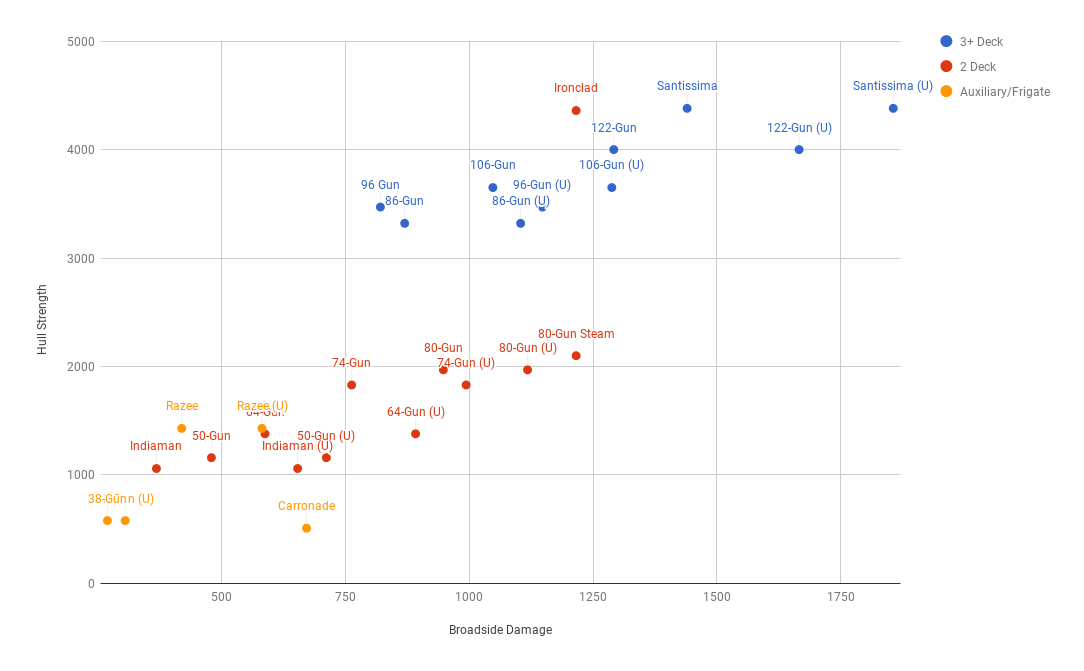
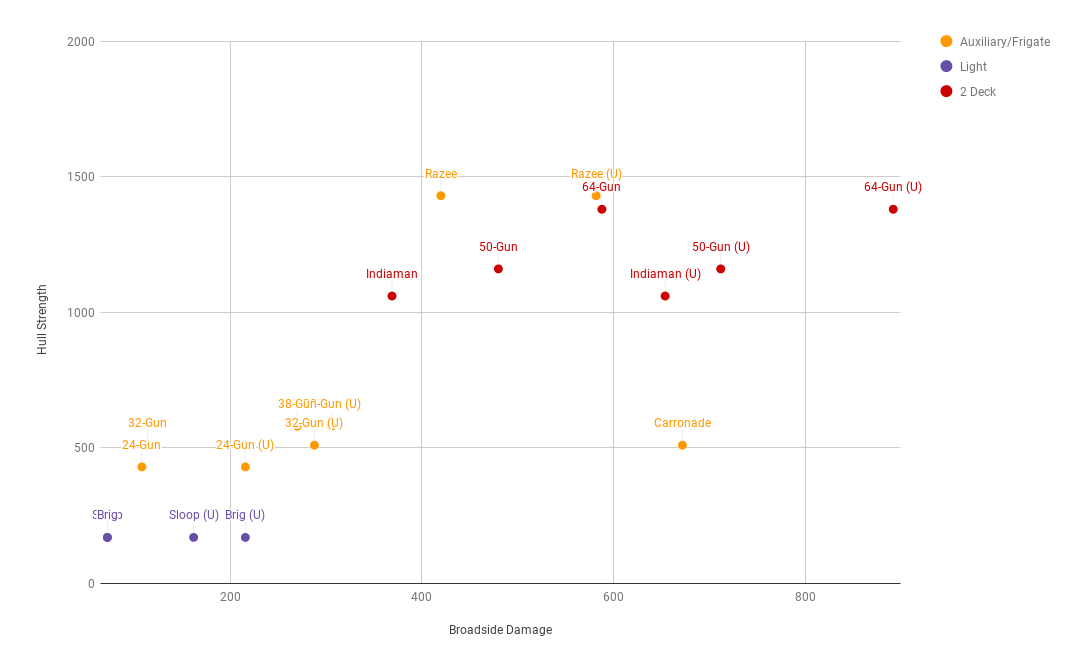
To get the real picture, the data files were processed and each ships roundshot damage was collated. The following charts show the main vessels plotted against the total broadside damage output (x-axis) and hull strength (y-axis). Broadside damage is calculated as the sum of roundshot damage for all guns on one side. Where a vessel's broadside is increased by Uniform Armament, a second plot is shown with "(U)" next to the name. As there was a clear distinction between the lower end and the top end, there are two overlapping charts to provide more detail.
Key points:- 3 deckers and larger are significantly tougher then 2-deckers but not always more powerful
- The Ironclad is a game changer for nations who can't build 3-deckers
- There's a clear performance gap between normal frigates and ships of the line
- Uniform Armament impacts some ships much more than others
- Razees and Carronade Frigates can tackle 50-Guns and Indiamen
Sailing Performance
Technology Advances
Naval related technologies are scattered throughout the Military and Industrial research trees. Several are not fully explained in the game so here is a summary of the effects of these technologies.
- Military: Improved Coppering
- Industrial: Bottling and Canning, Mass Production, Interchangeable Parts
- How to Dominate Land Battles★ 5 (1.7k)62k views2.5k ♥57 minUpdated Jan 31, 2018
- 《拿破仑:全面战争》汉化补丁 & 打开全特效 & 打开上帝视角★ 5 (943)27k views2k ♥1 minSimplified ChineseUpdated Dec 16, 2025
- How to Create a Democratic Government, without losing all your provinces★ 5 (252)26k views195 ♥1 minUpdated Dec 9, 2020
- How to win every historical battle on highest dificulty level.★ 5 (288)25k views442 ♥2 minUpdated Jul 11, 2021
- WATERLOO RECONSTITUTION★ 5 (493)24k views261 ♥1 minBulgarianUpdated Aug 6, 2015
- Unit Comparisons★ 5 (340)24k views499 ♥1 minUpdated Nov 15, 2013


- Upgrading to PremiumTeam Fortress 2★ 5 (20k)1441k views11k ♥6 minUpdated May 11, 2022
- No More Room in Hell Official ManualNo More Room in Hell★ 5 (2.8k)569k views2.1k ♥29 minUpdated Apr 22, 2019
- NMRiH Community Hosting GuidesNo More Room in Hell★ 5 (526)351k views653 ♥1 minUpdated Aug 10, 2022
- ULTIMATE GUIDE FOR GAME DEV TYCOONGame Dev Tycoon★ 5 (5.8k)326k views10k ♥4 minUpdated 23 Jan, 2014
- How to 'Git Gud' Soon™MORDHAU★ 5 (2k)318k views3k ♥68 minUpdated Nov 16, 2024
- Лучшие кооперативные игры SteamPAYDAY 2★ 5 (1.5k)315k views2.1k ♥56 minRussianUpdated Apr 27, 2025





This guide was created by its original author on the Steam Community. Are you the author and want it removed? Request removal.