Reference tables and notes
Introduction
When I play a game like Civ 3 I like to have tables with information about the different civilizations, buildings, and certain statistics to do with the game. I compiled all of these into an 11 page document that I print out and have at hand when I play Civ 3. I'm making these notes available to you in links at the bottom of this section.
In case you do not want to download a pdf I've also clipped the tables out of the document in image format and uploaded them here. In the pdf of the guid all of the notes are written out and ready to go when I click print. For the online version of this guide (eg, this thing you're reading) I will instead try to link to the original articles I made the notes from, when it is reasonable to do so.
In any case, here are the printable versions of this reference.
c3c references and notes, v1.0 (American "Letter" size paper), 750kb, .pdf:
mega.nz source[mega.nz]
c3c references and notes, v1.0 (European A4 size paper), 960kb, .pdf:
mega.nz source[mega.nz]
(Steam is removing the links to the pdf files. If you know how pdfs can be shared here tell me in the comments. In the meantime if you want the pdfs the links are visible on the thread I made about this guide in the Civ Fanatics forum):
Alternate links to paper guides[forums.civfanatics.com]
Keyboard Shortcuts
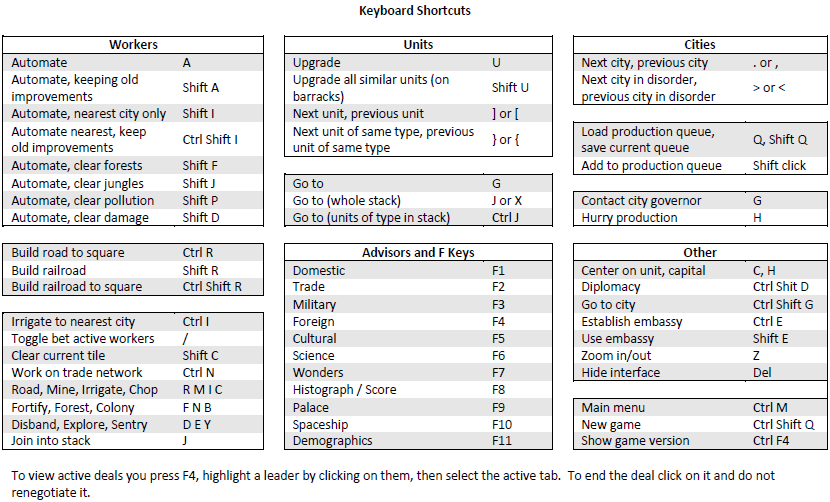 [click to enlarge]
Civilizations by Traits
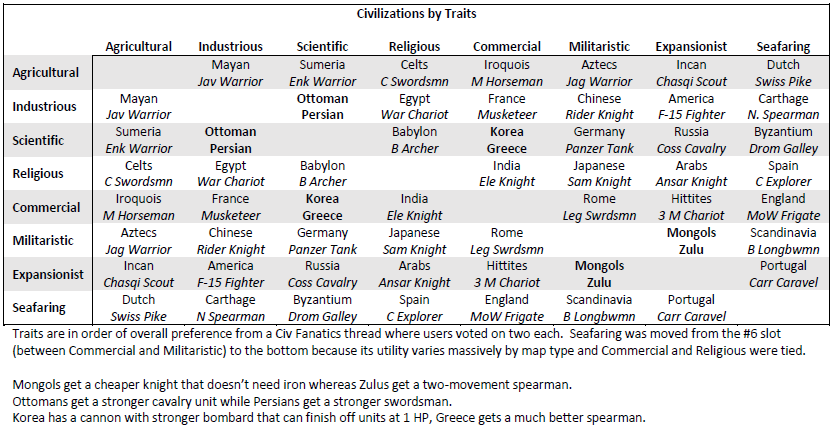 [click to enlarge]
Traits
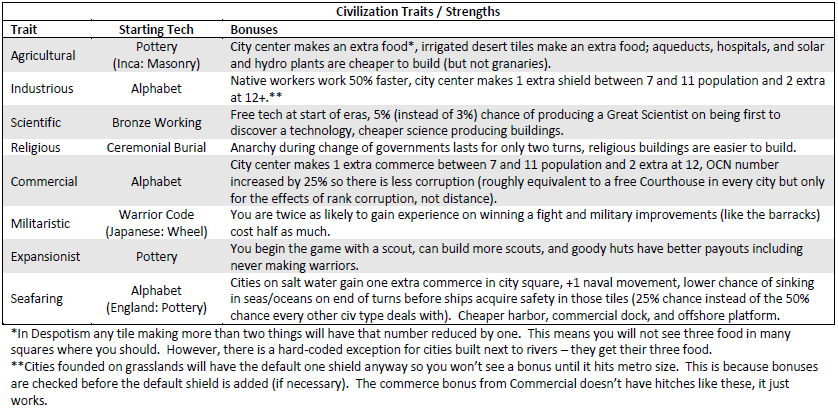 [click to enlarge]
Unique Units
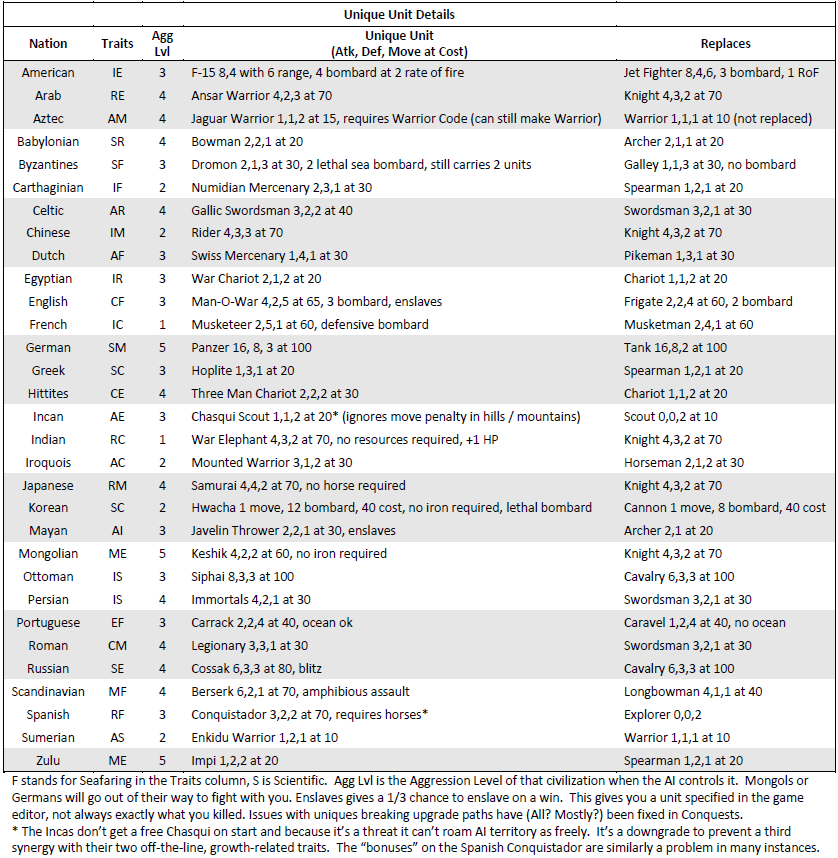 [click to enlarge]
Unit Promotion Odds
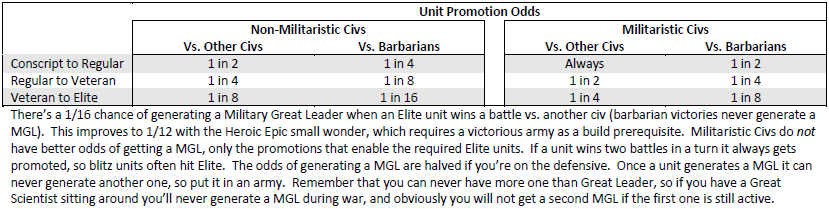 [click to enlarge]
Governments
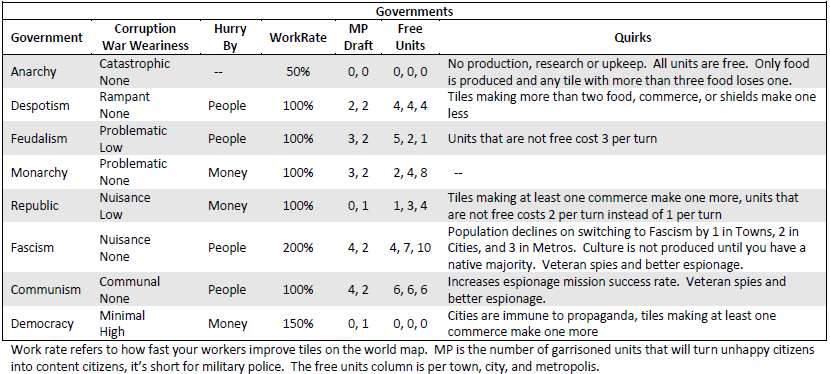 [click to enlarge]
Goody Hut Odds
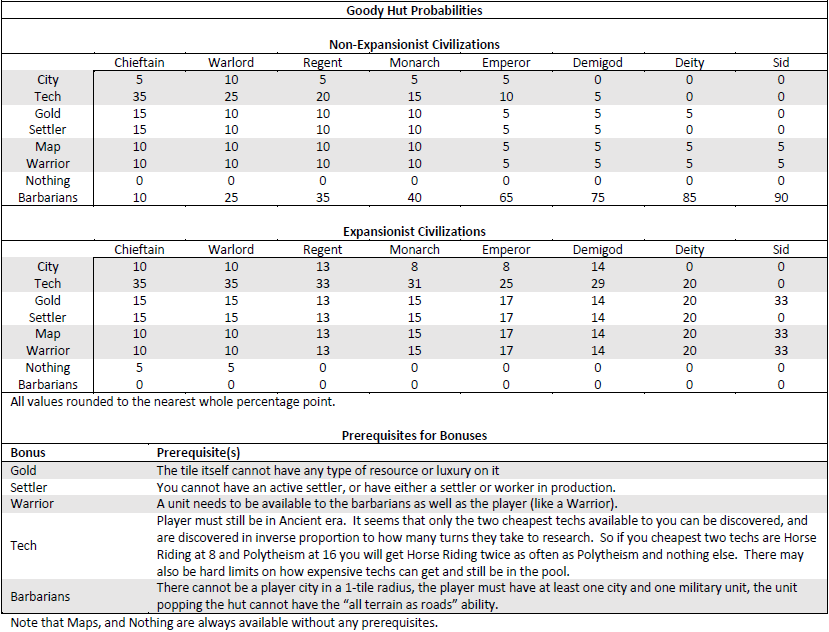 [click to enlarge]
City Improvements
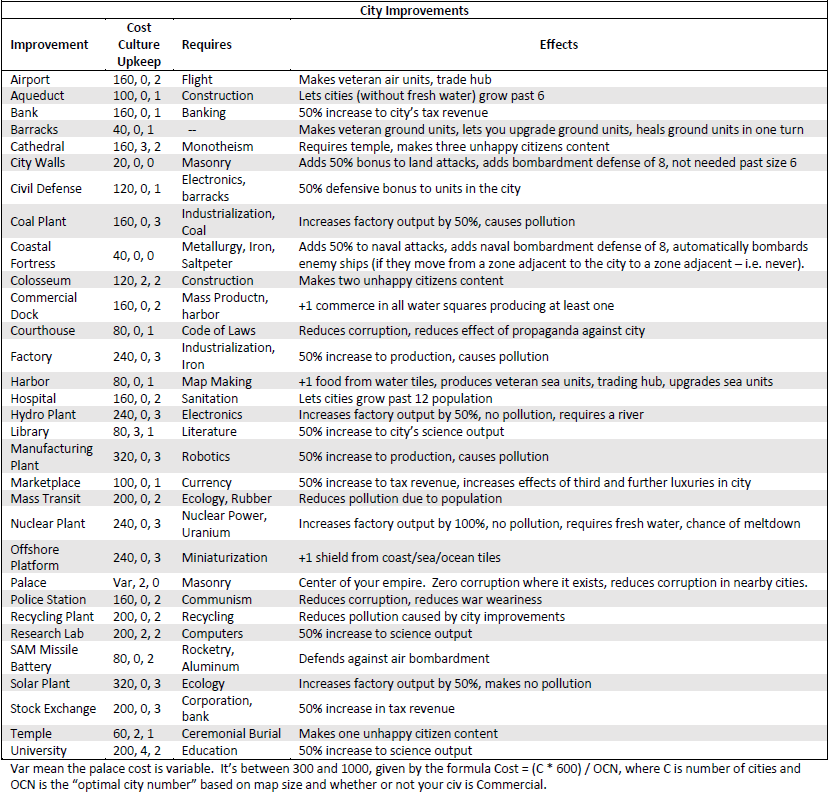 [click to enlarge]
Small Wonders
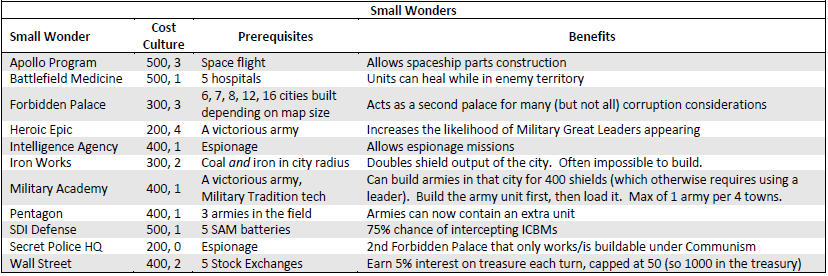 [click to enlarge]
Great Wonders
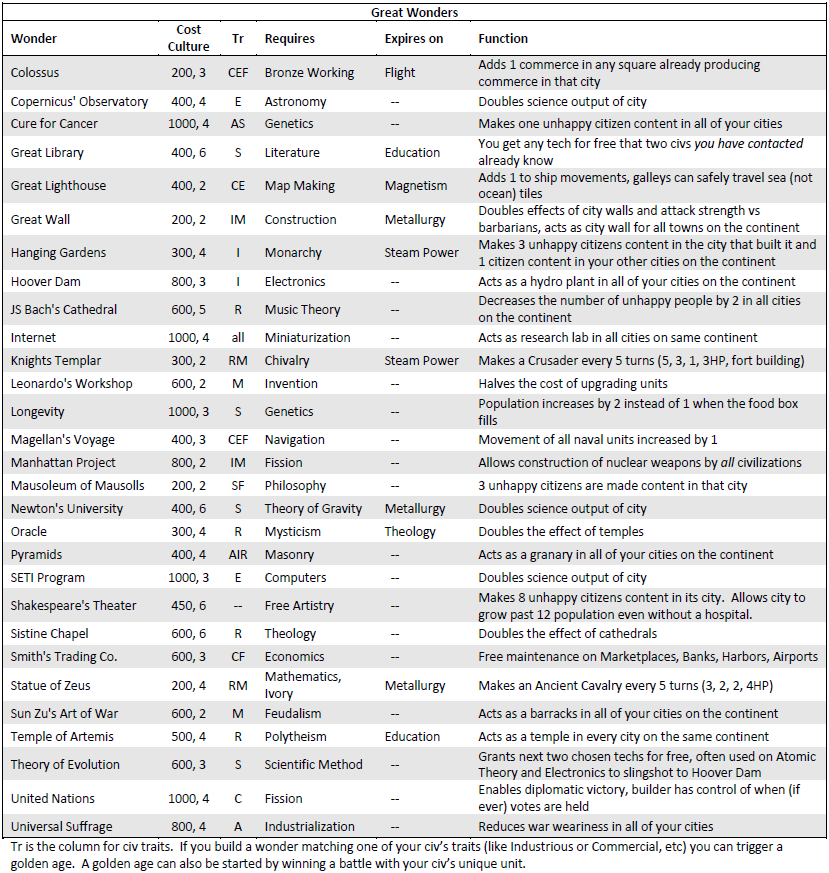 [click to enlarge]
Random Brief Notes
The first civ to discover Philosophy gets to choose a bonus tech for free. Map trades and Communication are pushed back to Navigation and Printing Press respectively.
Military Great Leaders cannot rush wonders, only small wonders and improvements. Scientific Great Leaders (3% chance of one appearing if you’re the first to research a tech, 5% if you’re also Scientific) can rush wonders or start an Age of Science, however the Age of Science is bugged and does nothing, so don’t use it.
There are some new bonus resources. The Oasis provides +2 food. Tobacco +1 commerce. Bananas and Sugar provide +1 food and +1 commerce.
You can make citizens into policemen (enabled by Nationalism, they are generally used near your core to avoid losing output due to corruption which is getting fed into improvements, note that they have no effect if the city is maximally corrupt – you have to get a hair under the cap somehow first) and civil engineers (enabled by Replaceable Parts, they make two shields that are immune to waste but which cannot be spent on units, only wonders and city improvements, and are used selectively in corrupt cities to get certain improvements in place).
The new Barricade (enabled by Construction) improvement made by workers increases defensive bonus to 100% and stops all enemy units trying to move through it that do not have Right of Passage. They maintain the Zone of Control that allows ranged units to snipe at passersby that Fortresses have.
If a Nuclear Plant melts down it halves your population in that city and pollutes the adjoining 8 tiles. It does not destroy any improvements, mines, roads, etc, and it does not convert plains to desert like an actual nuke does. Meltdowns only occur during civil disorder and never on the first turn of it. Nuclear plants are often used for Space Race victories.
Some great wonders can become tourist attractions beginning at 1000 years of age. There’s a reasonable page in the in-game Civilopedia about it. The Colossus produces more as a tourist attraction when it’s old enough than it probably did directly before it became obsolete.
Many exploits related to corruption were patched out. Ring City Placement no longer works, the Forbidden Palace has a small bonus effect on nearby cities and a nationwide effect (so it’s usually built nearer the core in C3C instead of rushed at a distance). Courthouses and Police Stations now have a greater effect on really distant corruption and either one will lower a city below maximal corruption (making police officers functional after they’re built). There is a detailed section on corruption later on with more details. Communism has much less corruption than it used to, even without the new Secret Police HQ small wonder.
Units are more expensive to upgrade than they used to be (difference in shields times three instead of times two).
Bombarding an empty square creates craters that have to be cleared before they can be re-roaded or otherwise improved. The ruins from razed cities don’t change production values for their squares but if you don’t like how they look any improvement built there will clear them. They’ll be missing roads anyway since those went away with the city that was there.
Captured workers do not cost you maintenance and make good body walls, population boosts once you conquer the foreign civ, etc.
Cultural borders expand when the city hits 10, 100, 1000, and 10,000 lifetime culture.
If you’re missing a trade option in the diplomacy screen you likely need to research either Map Making, Writing, build an Embassy, or Nationalism.
The OCN number is 14, 17, 20, 28, 36 for tiny, small, standard, large, huge maps. It’s modified by difficulty by 100% at Chieftain, 95% at Warlord, 90% at Regent, 85% at Monarch, 80% at Emperor, 70% at Demigod, 60% at Deity, and 50% at Sid. Being a Commercial civ increases it by 25%. Building the Forbidden Palace or the Secret Police HQ increases the OCN. If you are not in Communism the FP increases OCN by 37.5% and the Secret Police HQ has no effect even if built. In Communism both the FP and SPHQ increase the OCN by a much larger amount (figures online of 150% were mentioned for each small wonder but were not correct, in any case it’s a lot more than 38%, although those numbers then go through the Communism calculations so they’re not quite as dominant as they seem).
You get one pollution point for each citizen over 12 in a city, plus those from buildings. More points = more chance of a tile getting fouled up.
Settling and Build Orders
Settling on a river saves you building an aqueduct, settling on the coast lets you build a harbor for more food. If you settle on a food bonus you lose the food bonus, however you don’t lose shield or commerce bonuses on tiles (apart from Despotism penalties).
A typical build order for your first city goes warrior (explore), scout (if able, otherwise skip), granary, settler, warrior (fortify), settler, worker (mines), scout, settler, spearman (fortify, send warrior to explore), warrior, settler, worker (roads), wonder. A typical build order for core cities is warrior, granary, settler, worker (roads), warrior, settler, spearman, settler, spearman, temple, worker.
This is all very coarse advice that should be supplemented with the ideas very well laid out in the “Babylon’s Deity Settlers” article:
Babylon Deity Settlers[www.civfanatics.com]
Settler Pumps
Settler Factories[www.civfanatics.com]
Notes on Workers
While you’re in Despotism don’t irrigate grassland unless it has some kind of food bonus. Until you have railroads you generally will irrigate most plains and mine most grasslands. Putting down a road under any tile that’s being worked but doesn’t have one is a good default option.
Notes on Armies
The short of it is that people generally load their armies up with as many veteran (not elite), fast moving, offensive units as they can. Elite units are usually kept out of armies because armies cannot generate Military Great Leaders and 12HP should be plenty to keep your army alive. To get an army you take a MGL into any city and click a button, or you can build one in a city with the Military Academy small wonder, which itself requires that you’ve had an army win a battle previously and that you’ve researched Military Tradition (same tech for Cavalry). You can only have one army for every four settlements but losing a settlement cannot delete your army.
An army has an attack score given by the following formula, rounded down to the nearest integer.
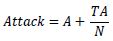
Where A is the attack value of the unit visibly attacking, TA is the sum of the attack power of the units in the army, and N is 4 if you have the Military Academy small wonder, or 6 if you do not. The Defense number is the same but with defensive values swapped in where appropriate. An army’s movement speed is whatever its slowest unit is +1. Armies always have blitz (can attack more than once) and radar (can see two tiles regardless of terrain). They always heal at a rate of one HP per unit per turn. They always get a defensive bonus for improved terrain even if the terrain is not improved. Armies can pillage without using up movement points.
Armies can always heal in enemy territory. It increases from 1 HP per unit per turn to 2 when you build Battlefield Medicine. They heal even faster in native territory. You can only have one army for every four cities you have, but losing a city cannot take away an existing army. Armies without units in them move at a rate of 2 on roads instead of 3. The “army” unit itself counts as a unit if you’re trying to put it in a ship, so for a three-unit army you need a ship that can hold four units – the “army” itself also draws support money in addition to each unit in it.
Units in armies cannot be upgraded. Special abilities like amphibious assault will only be had by the army if all units in the army have it. Armies cannot do worker functions even if they have a worker (or all workers) in them. Armies never spawn great leaders on combat, even if their units are elite units. The units in an army should be able to gain experience but there is a bug where often (always?) only one unit can do this.
The AI rarely uses its Great Generals to build armies and therefore almost never has them. It’s also scared of armies and rarely attacks them.
Cheesy Free Capital City Jump
(This info comes from a thread elsewhere which I can no longer find. If you find it mention it in the comments and I'll add it in here.)
Using We Love The King Effectively
The Roads Around The Capital
Scouts and Explorers
Corruption
Corruption gets bad quickly in Civ 3, especially since in order to keep up with the built in advantages the AI gets on higher levels human players tend to go for huge empires to compensate. The corruption system is complex and it saw major changes in every version of Civ 3 that came out.
Luckily the one in Civ 3 complete is the most intuitive and transparent one, and c3c gives you the most options for fighting it (if you decide it's even worth it to try -- sometimes a productive core is enough). The most important thing to know is that previous exploits like Ring City Placement have been patched out, so you can mostly do what you think you should and at least see some results. Also, if you haven't tried it, switching to Communism can be very powerful for huge empires late game, be sure to give it a shot.
In the paper version of this guide I very slightly rewrote and reformatted a very detailed and important forums post that described the the corruption sytem in very careful detail, including mathematical formulas, and some rules of thumb.
You can still find the original thread here:
Everything About Corruption: C3C edition[forums.civfanatics.com]
- HOW TO WIDESCREEN ON WINDOWS 11 (Windows 10, Windows 8 and 7 too)★ 5 (224)18k views284 ♥3 minUpdated Mar 19, 2025
- Disable game INTRO and setup High Resolution★ 5 (198)14k views167 ♥1 minUpdated Feb 27, 2025
- Modding and Mods★ 4 (93)11k views182 ♥3 minUpdated Jul 9, 2022
- Keyboard Shortcuts★ 5 (157)6.2k views239 ♥2 minUpdated Sep 3, 2020
- Suede's 12 Turn Start Guide to QC★ 4 (45)5k views45 ♥8 minUpdated Aug 24, 2017
- Civilization III Conquests: The Army unit★ 4 (39)3.8k views20 ♥5 minUpdated May 2, 2015



- Upgrading to PremiumTeam Fortress 2★ 5 (20k)1441k views11k ♥6 minUpdated May 11, 2022
- No More Room in Hell Official ManualNo More Room in Hell★ 5 (2.8k)569k views2.1k ♥29 minUpdated Apr 22, 2019
- NMRiH Community Hosting GuidesNo More Room in Hell★ 5 (526)351k views653 ♥1 minUpdated Aug 10, 2022
- ULTIMATE GUIDE FOR GAME DEV TYCOONGame Dev Tycoon★ 5 (5.8k)326k views10k ♥4 minUpdated 23 Jan, 2014
- How to 'Git Gud' Soon™MORDHAU★ 5 (2k)318k views3k ♥68 minUpdated Nov 16, 2024
- Лучшие кооперативные игры SteamPAYDAY 2★ 5 (1.5k)315k views2.1k ♥56 minRussianUpdated Apr 27, 2025





This guide was created by its original author on the Steam Community. Are you the author and want it removed? Request removal.