Baldur's Gate Mechanics for Non-D&D Players
7 Things Before Playing (read this if nothing else)
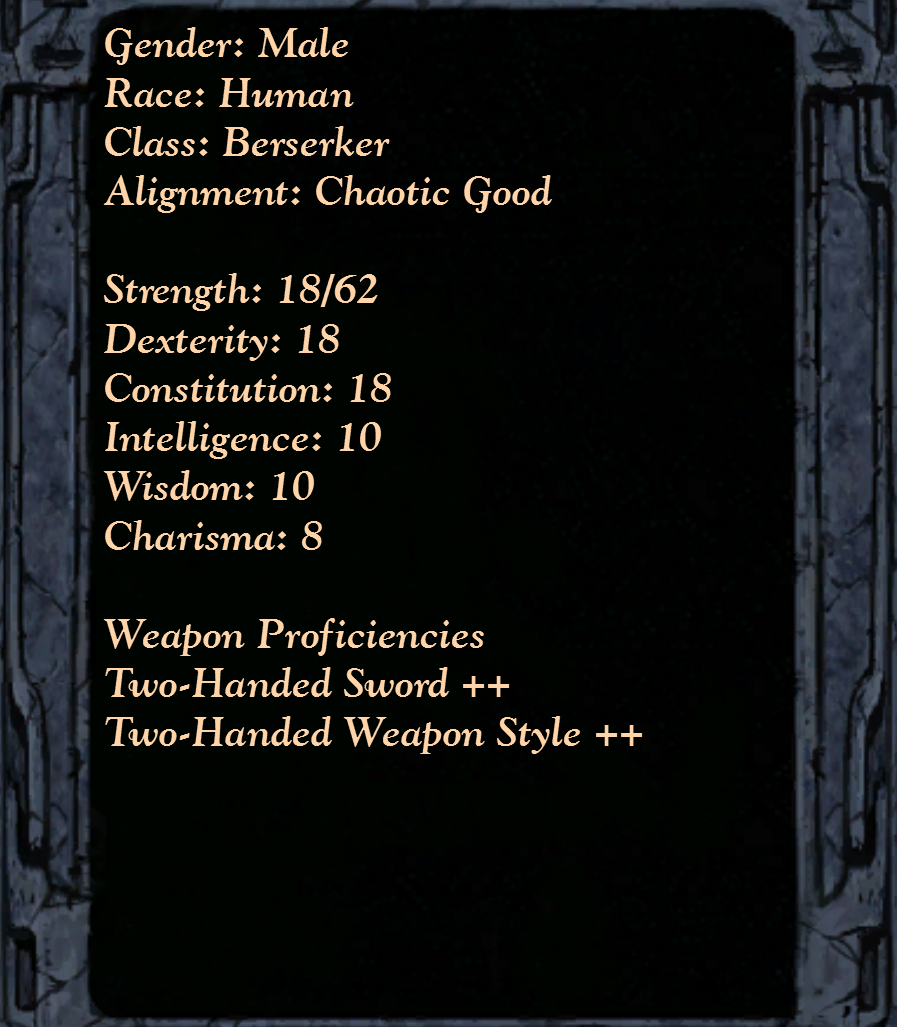
- Roll until you get 80+ in stat points. Maximize (18) your class's primary stat, followed by Constitution. Don't worry about the second number beside "Strength", if any.
- THAC0 is your "chance to hit," AC is your "chance to avoid hits." These should be low or negative, and weapons and armor (beneficially) decrease them. Later versions of the game color-code equipment comparisons to remind you of this system.
- Do not use weapons that a character is untrained in. Do not dual-wield if without training either. Characters suffer extensive combat penalties for doing so.
- Memorize spells in the spellbook before casting them. Mages learn new spells from scrolls. Spells are "recharged" by resting. A spellcaster for the main character makes for a challenging first playthrough, due to the need to understand dozens of different spells.
- Attacks displaying the "no effect" combat message are probably due to using lesser-enchanted weapons (such as +1, +2, etc.). Stronger enemies often have protections against lesser armaments.
- If the main character dies, the game immediately ends and you must reload a previous save. Therefore, a tanky main character makes the game easier, since you can revive your other party members if they die, but they can't revive you. I.e., a Fighter main character and a Wizard party member is an easier combination than the other way around.
- Every 1 point change in THAC0, AC, save chance, etc, is about a 5% change.
Character Creation
- 18 points in your primary stat, as noted by your character class page.
- Any class is viable, there are plenty of early NPC's to balance the party.
18 is the highest any stat can be at character creation (excluding racial bonuses). Try to maximize your class's "primary" stat, noted on the class selection screen. Other stats (such a constitution to increase hit points) should be 15+ to gain a benefit. Stats lower than 10 usually penalize your character in some way.
You have unlimited re-rolls in Baldur's Gate when rolling your characters stats. A high roll is 80 or higher. Continually re-rolling for a few more points has a negligible impact and delays getting into the action. The odds of an 80+ is about 1 in 100. For fun, the odds a perfect 108 roll is about 1 in 1.5 billion. I wouldn't keep trying for it.
Edit for D&D nerds: There's a debate over the algorithm used to generate Baldur's Gate scores, and the developers have changed it at some point. In typical D&D, players roll either 3d6 or 4d6 and drop the lowest die, for a result of 3-18, though Baldur's Gate will increase low rolls to the minimum required for the chosen class, and may weight the rolls in other ways. The point remains that trying to roll perfect scores is a waste of time with negligible impact on the game.
A "balanced" party typically consists of a melee warrior (fighter, barbarian), a thief (or trap disarmer/chest unlocker), an arcane spellcaster (mage, sorcerer), and a divine spellcaster (cleric, druid).
However, NPC's will usually not perfectly fit into this mold, and Baldur's Gate offers six party members, giving a chance to mix-and-match alternatives.
Weapons and Combat
- AC is your chance to avoid weapon hits, the lower, the better.
- Only use weapons you have invested skill points in.
- Damage numbers are represented by dice rolled.
- Combat is internally broken up into "rounds", though the game presents it as real-time.
Physical attacks either hit and do full damage, or miss and do no damage. AC only increases the chance to avoid a hit; it doesn't reduce injury from a successful hit. AC does not influence avoiding spells.
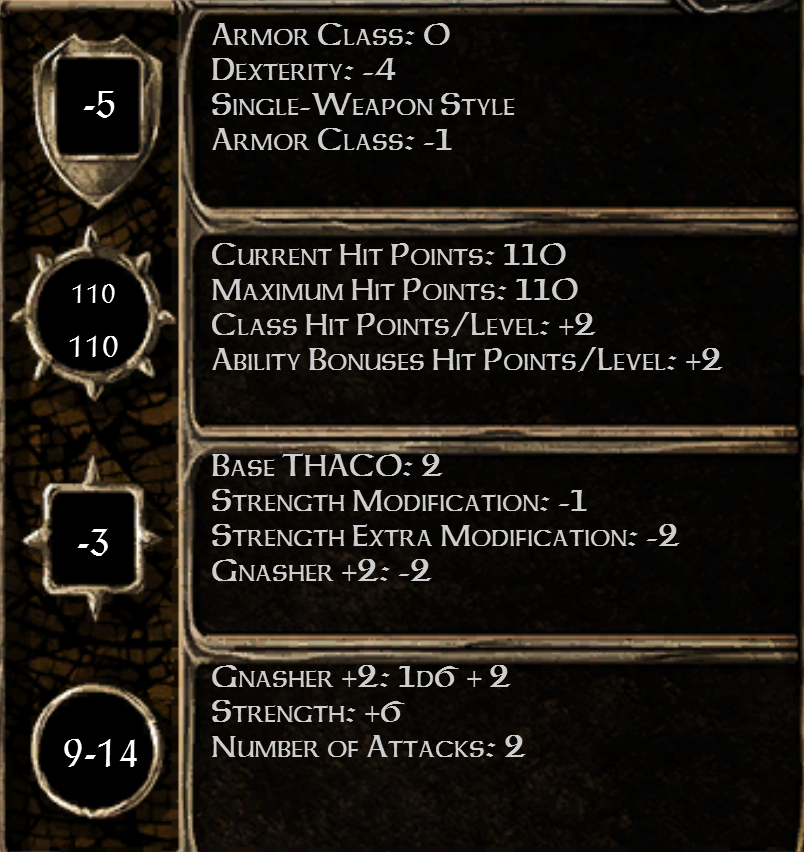 This character has a -5 AC, 110 Hit Points, -3 THAC0, and does 9-14 damage each round. The boxes on the right show where these benefits came. For example, the "Gnasher +2" weapon is reducing THAC0 by 2 -- an example of an item (beneficially) decreasing a number instead of increasing it. Note: Future patches made these screens look slightly different, but the underlying mechanics remain the same.
AGAIN, IMPORTANT: AC and THAC0 should both be as low as possible. Equipping armor or investing in weapon points lowers both of these values. It will be very apparent if an item detriments a character (such as a cursed item). You will never become weaker from leveling up, even if some numbers on the character sheet decrease.
Advice: Never dual-wield without the appropriate skill, as it incurs significant penalties when attacking. Additionally, never use a weapon that your character isn't proficient in unless you find yourself in a dire situation where your primary weapon is ineffective against the enemy.
Spellcasting
- Mages learn new spells from scrolls, Sorcerers select new spells at level up.
- Divine spellcasters have an innate knowledge of all their spells and do not need to learn them.
- Most casters prepare their desired available spells in their spellbook.
- Spells are castable once per memorization and are recharged when the party rests.
- Saving Throws (a "save") offers a chance to diminish/avoid some spell effects, much like AC for spells. The lower the better.
Divine casters all have an innate knowledge of every spell accessible to them based on their class level, and new ones become available automatically.
Bards and Sorcerers prepare spells differently than Mages. Instead of memorizing specific spells ahead of time, they can cast any of their known spells at any time, up to some number of "casts" per day. They must still rest to regain their "casts" once they exhaust them.
In summary, Mages know more spells but can cast fewer per day and must plan their use, while Sorcerers know fewer spells but can cast more per day and without planning. Either class learns the same pool of spells otherwise; only the method of memorization and casting differs.
Specialist mages gain an extra spell slot of each level, but cannot cast spells from an opposing school. For example, a Necromancer cannot cast Illusion spells. Specializing often makes initial playthroughs much more difficult, due to the lack of "counter" magic.
Examples of total known spells and available spells per day of different classes (same level).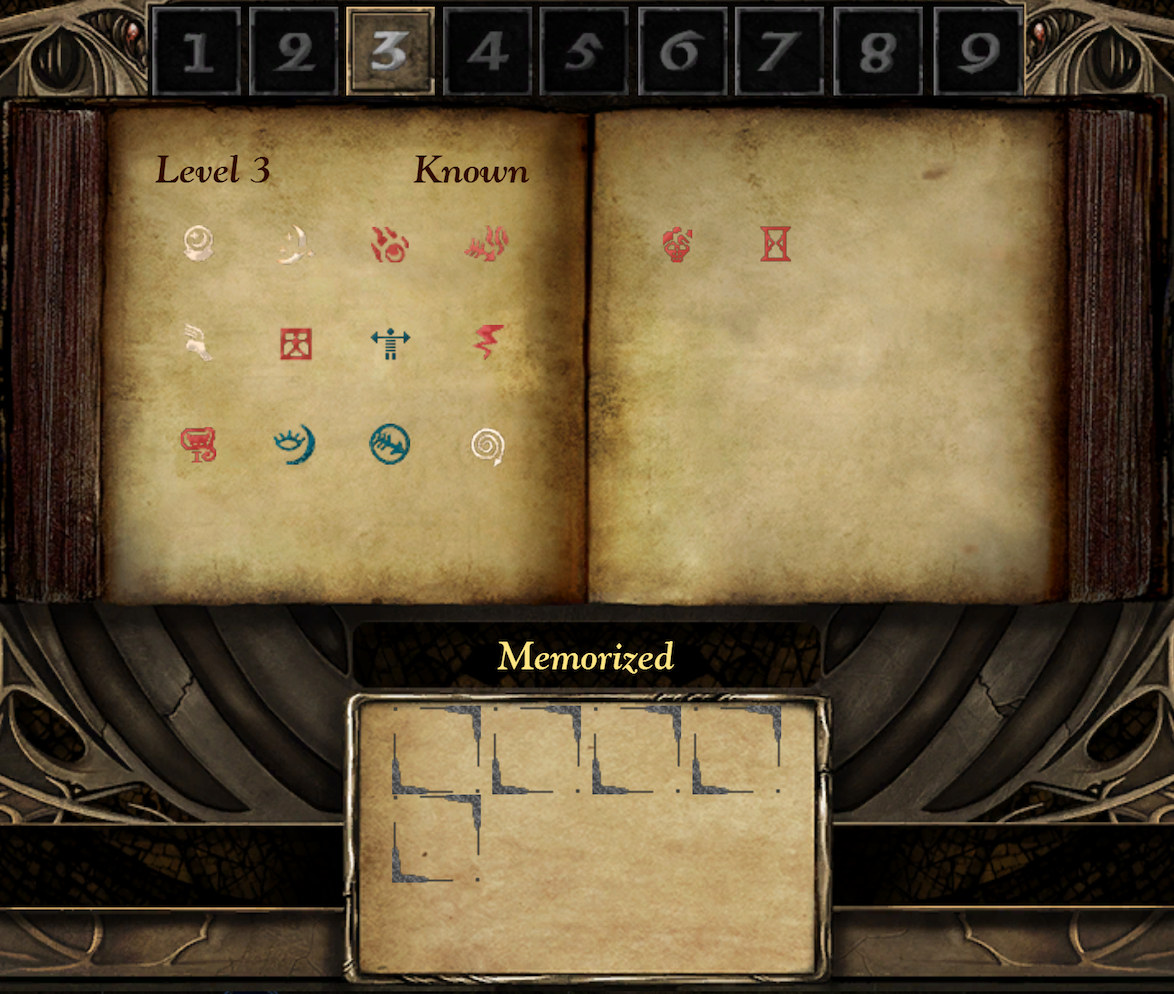
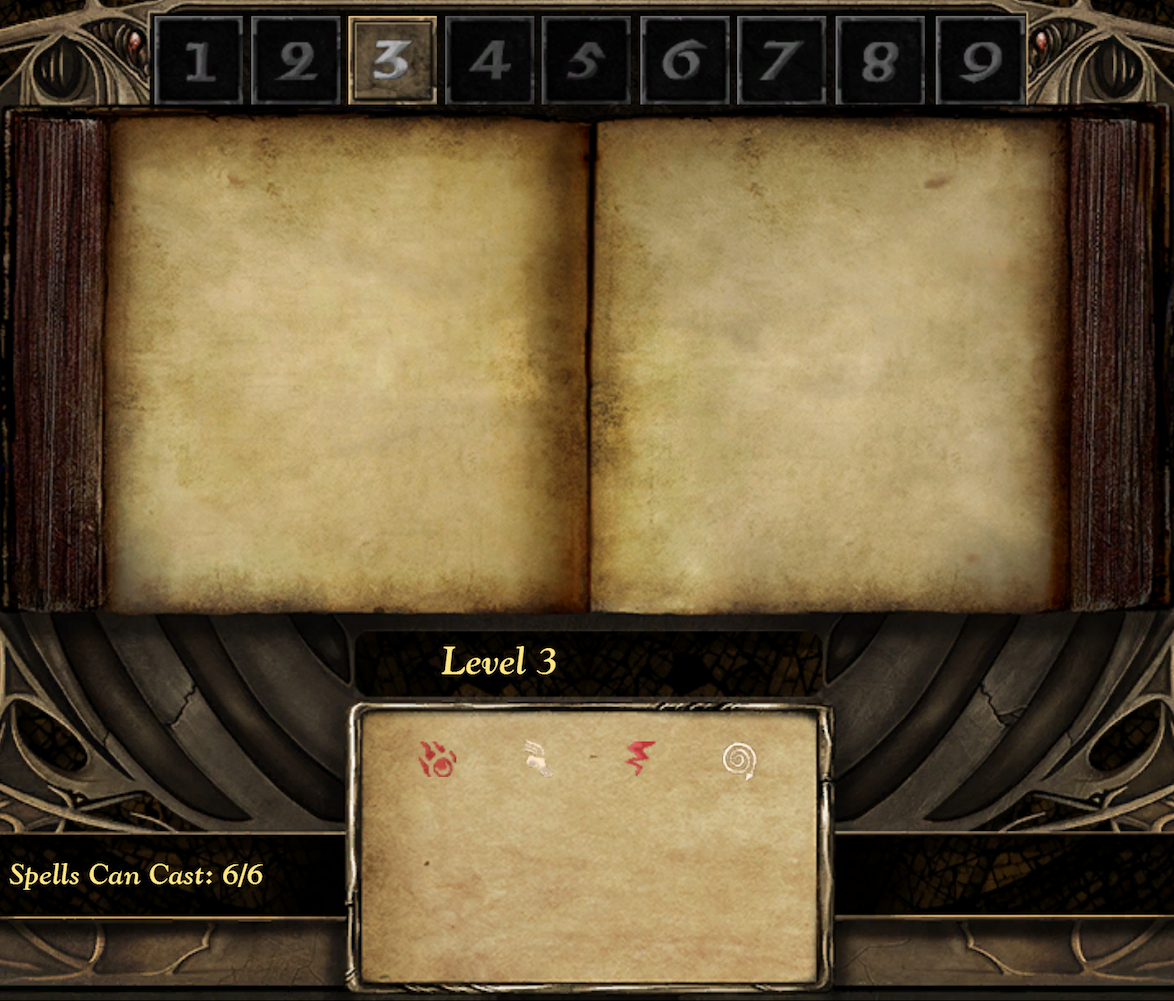
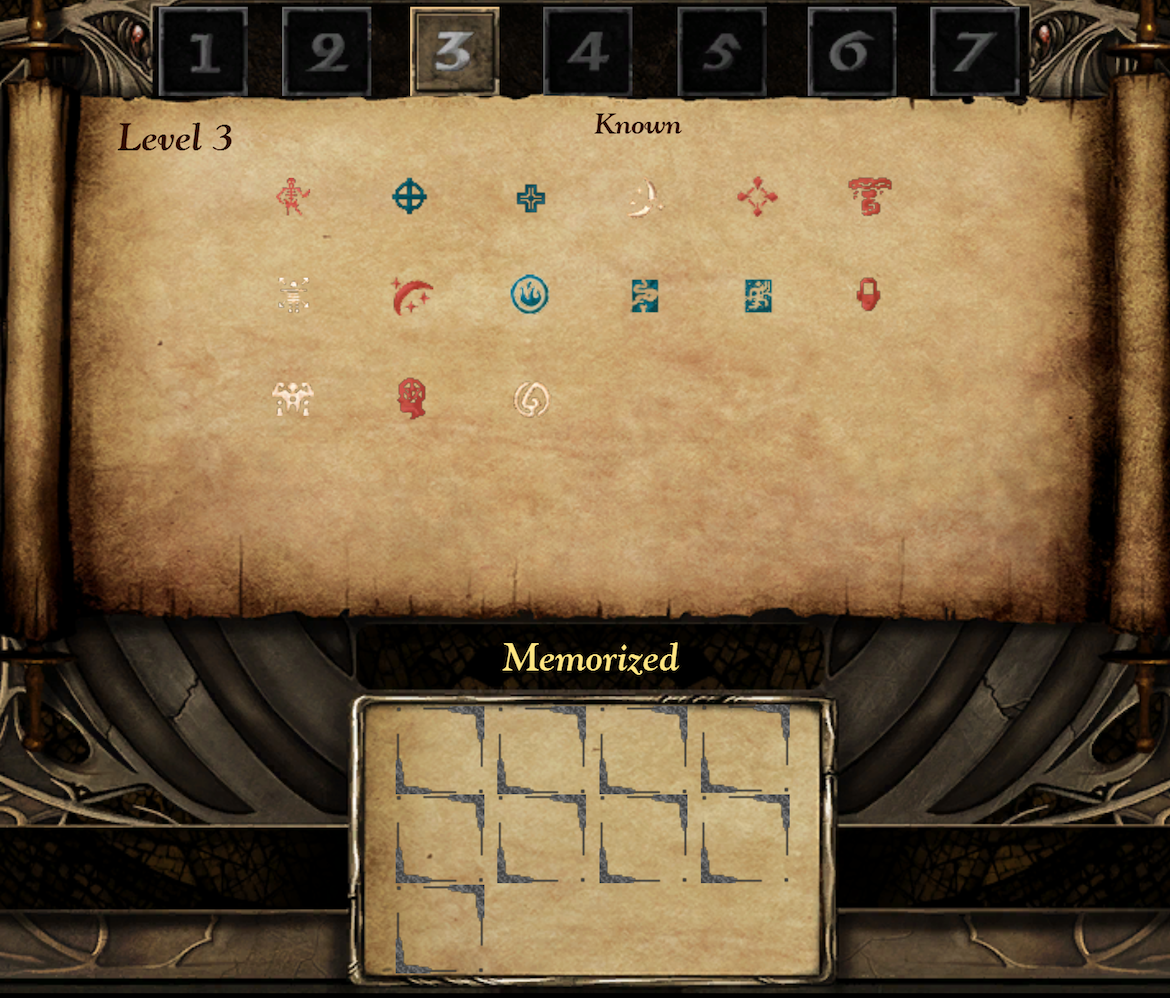
For instance, Fireball has a 1/2 save vs. spell. Characters hit by a fireball who succeed in their saving throw take half damage from Fireball. Characters who fail take full damage. Some spells, such as Finger of Death, instantly kill their target if the saving throw fails. Not all spells offer a saving throw.
Like AC and THAC0, saving throw numbers should be low or negative. Also, like THAC0 and AC, an item which gives you "+2 to Saving Throws", (beneficially) reduces your saving throws by 2.
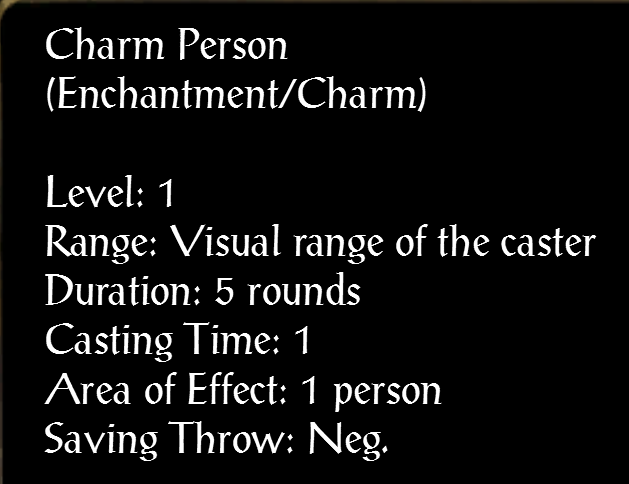
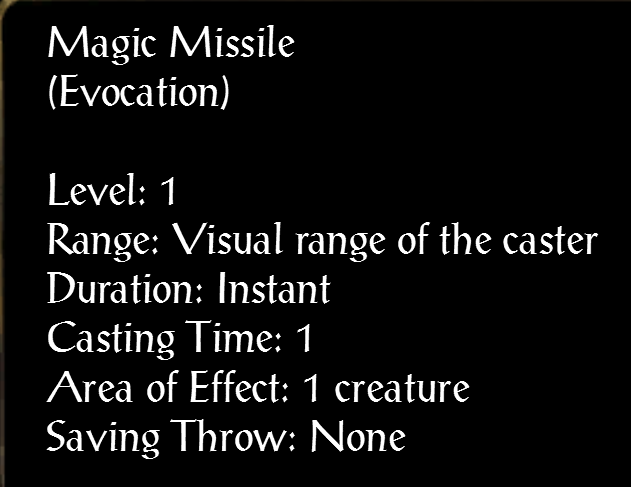 Two different spells, one offering a full save (negating the spell), and one offering no save at all.
If a direct spell can't target an enemy spellcaster, they're probably under the effect of an illusion spell such as Shadow Door. Dispel such spells with True Sight or another illusion-breaking spell. area-of-effect spells such as Fireball or Death Cloud still affect such enemies.
If an enemy spellcaster appears immune to weapon attacks, but a "no effect" message doesn't display, they're probably under the effect of Stoneskin. Stoneskin absorbs 5-10 hits before wearing off.
FAQ and Miscellaneous Information
Pick Pockets is a percentage as well, but modified by the weight of the object the character steals. Stealing from merchants uses Pick Pockets' skill level as well.
Move Silently and Hide in Shadows are not directly percentage-based, and depend on visibility and the environment. For stealth calculation reasons, ignore Hide In Shadows entirely in favor of Move Silently.
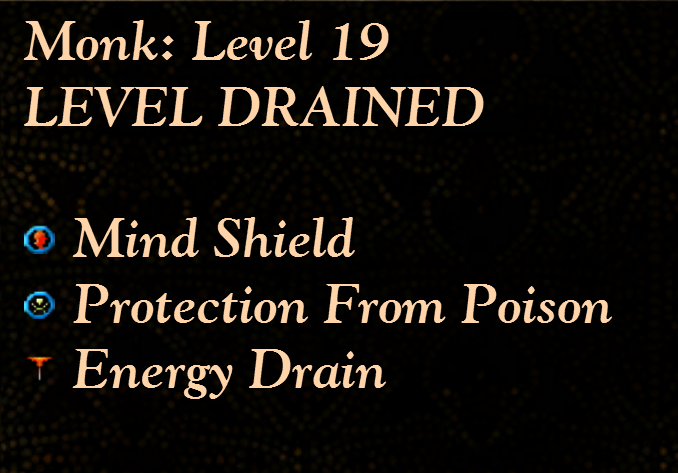 Some enemies, like the undead, can inflict level drain when they hit a character. Level drain modifies the afflicted characters stats as if they were at a lower experience level; this can (negatively) reduce things such as THAC0 and the number of available spells.
Note that if a spellcaster becomes affected by level drain, some of their spell slots may be empty after restoration and will need re-memorization.
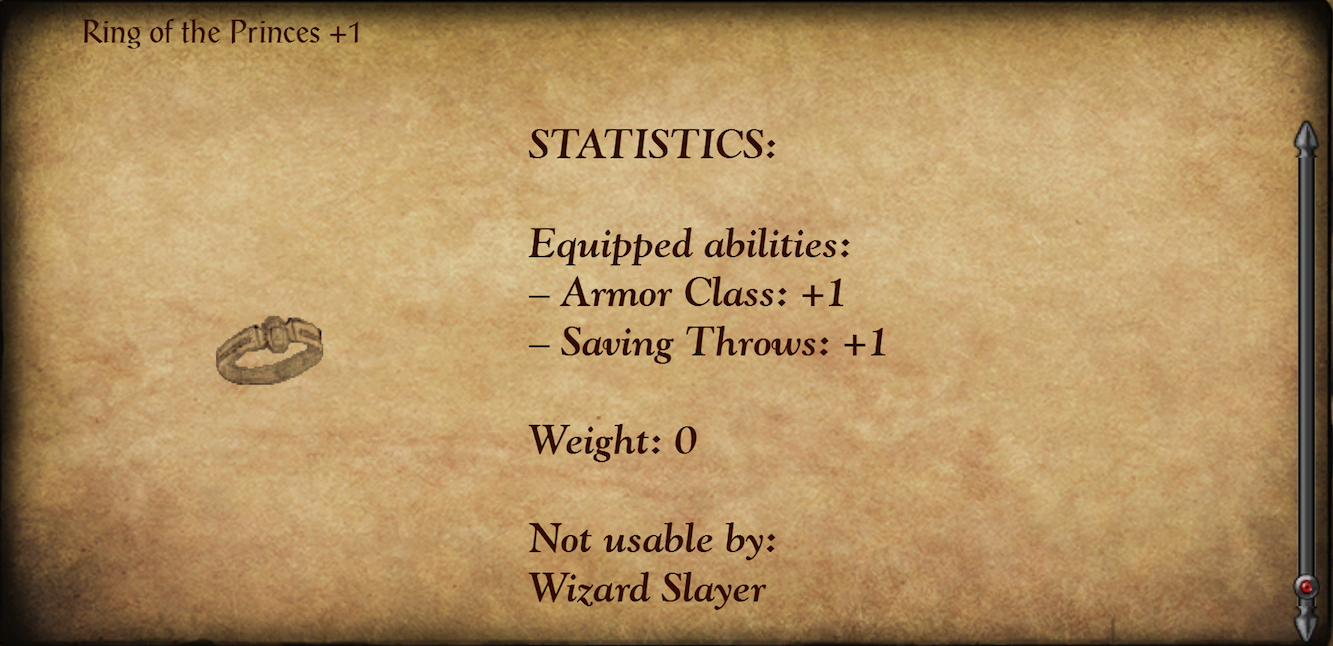
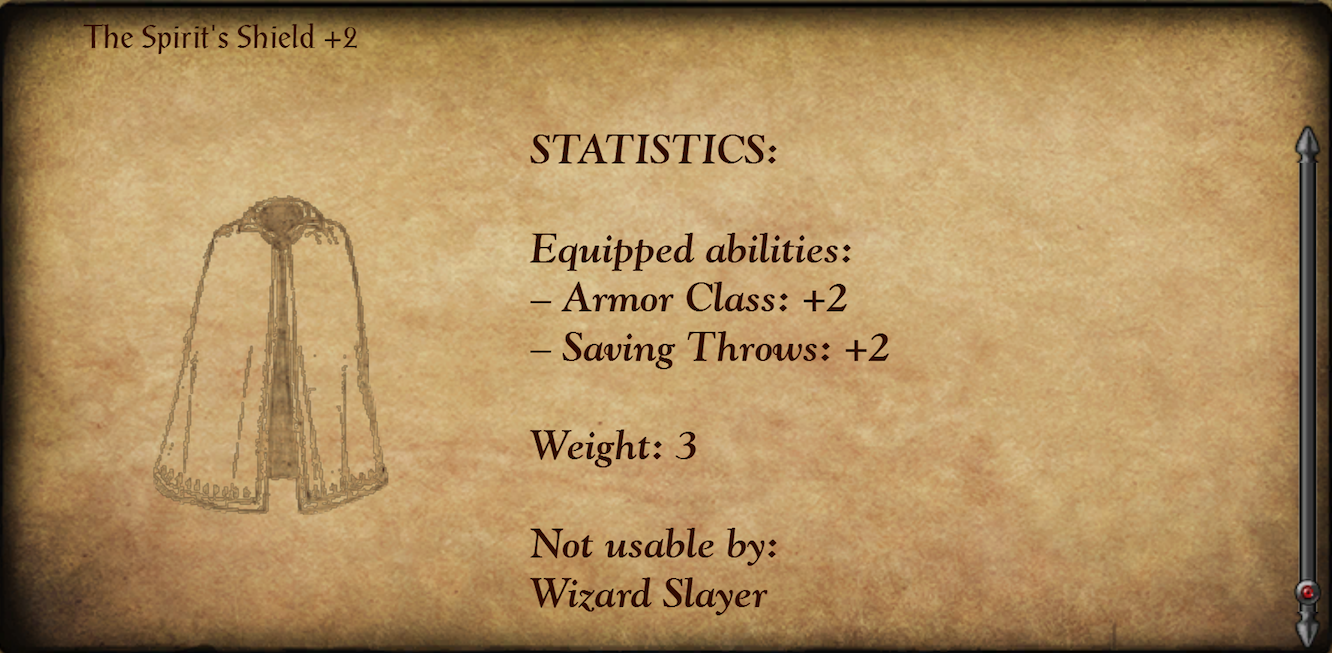 Ring of the Princess +1 and The Spirits Shield +2 cannot be equipped at the same time because they offer the same bonus, even though their bonus amounts differ.
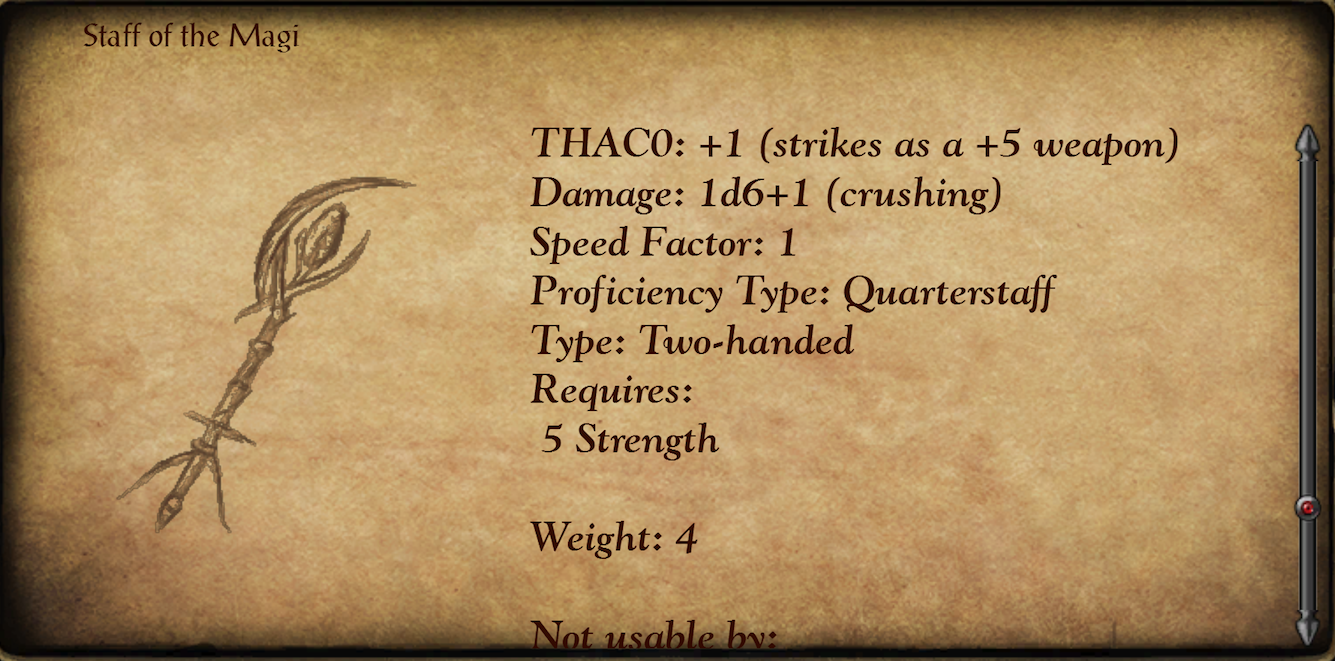 A few weapons, such as Staff of the Magi, count as enchanted weapons even if they don't have a + in the name.
IMPORTANT: Some spells make the caster immune to magical weapons. In this case, only an unenchanted weapon (or ammunition) can strike the caster.
- Baldur's Gate: Enhanced Edition Ultimate Guide★ 5 (1.3k)57k views3.3k ♥19 minUpdated Oct 15, 2016
- NPC Guide for BGEE (and SoD)★ 5 (561)29k views1k ♥169 minUpdated Dec 24, 2021
- Custom Portraits Guide★ 5 (465)24k views550 ♥8 minUpdated Jan 12, 2024
- Locations of all tomes to permanent increase stats★ 5 (332)18k views672 ♥2 minUpdated Jan 8, 2016
- Baldur's Gate: EE - Achievement Guide. Excl Siege of Dragonspear★ 5 (561)17k views885 ♥14 minUpdated Dec 16, 2019
- Baldur's Gate: Enhanced Edition - Achievements Guide★ 5 (458)17k views1k ♥14 minUpdated Jun 17, 2024




- Upgrading to PremiumTeam Fortress 2★ 5 (20k)1441k views11k ♥6 minUpdated May 11, 2022
- No More Room in Hell Official ManualNo More Room in Hell★ 5 (2.8k)569k views2.1k ♥29 minUpdated Apr 22, 2019
- NMRiH Community Hosting GuidesNo More Room in Hell★ 5 (526)351k views653 ♥1 minUpdated Aug 10, 2022
- ULTIMATE GUIDE FOR GAME DEV TYCOONGame Dev Tycoon★ 5 (5.8k)326k views10k ♥4 minUpdated 23 Jan, 2014
- How to 'Git Gud' Soon™MORDHAU★ 5 (2k)318k views3k ♥68 minUpdated Nov 16, 2024
- Лучшие кооперативные игры SteamPAYDAY 2★ 5 (1.5k)315k views2.1k ♥56 minRussianUpdated Apr 27, 2025





This guide was created by its original author on the Steam Community. Are you the author and want it removed? Request removal.