Combat Width & Terrain: Data Analysis EN (v1.19) 07/2026
Why this guide is different
Thanks to u/lillelur and u/Emzatin from Reddit — if it weren't for them, I wouldn't have put in this much effort!
https://steamcommunity.com/sharedfiles/filedetails/?id=3766078597
Almost every division guide hands you a ready-made "meta": copy this template, use this width, done. The problem is that nothing in HOI4 is exact — what exists is what performs well or badly in each situation. This guide doesn't give you a single answer; it gives you the numbers so you can decide.
Everything here was extracted straight from the game files (Operation Postern, v1.19) — combat width, each unit's terrain modifiers, attrition, supply. It's not guesswork or a wiki copy: every value comes from a game file and can be checked. On top of that, I built views that answer practical questions:
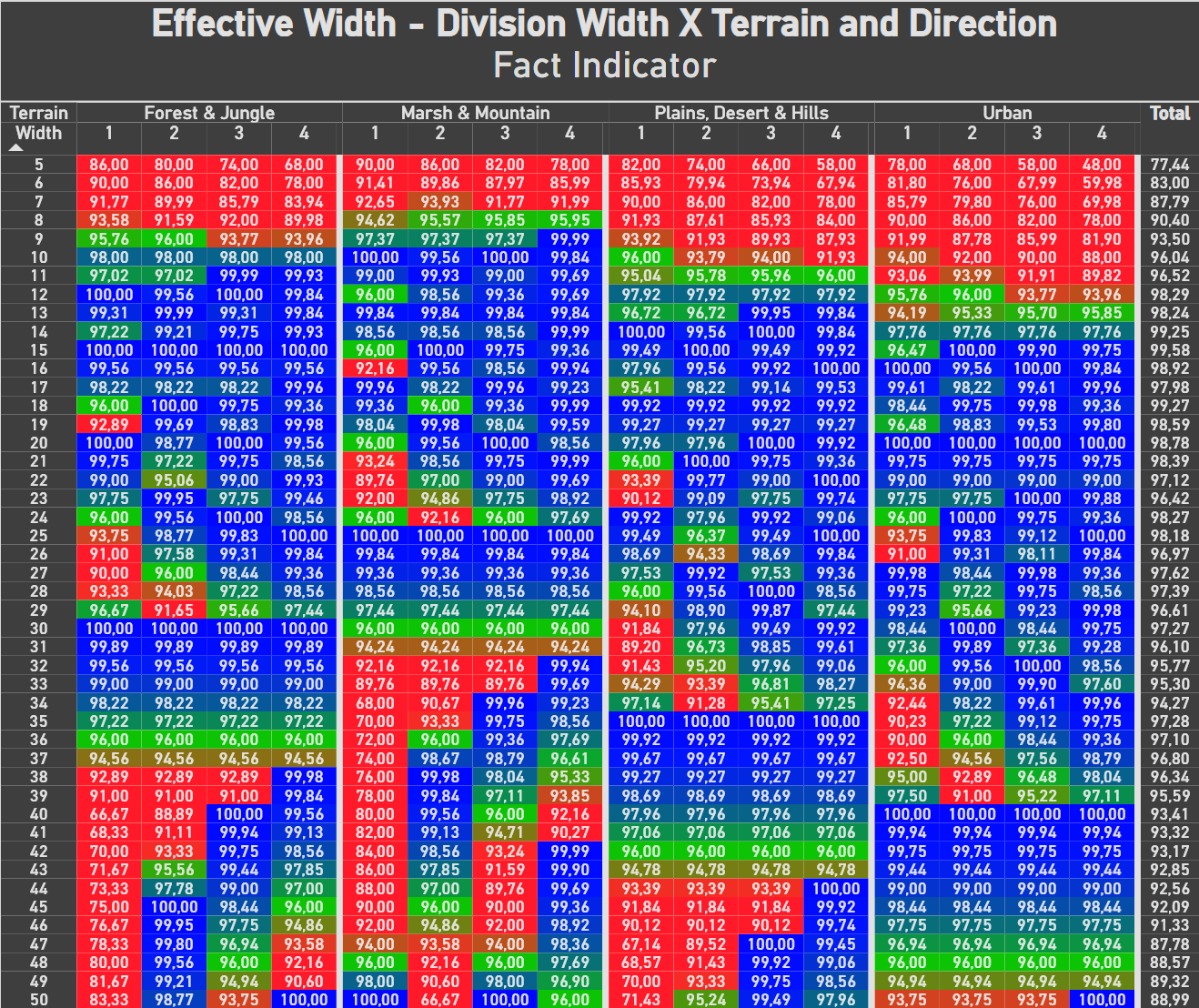
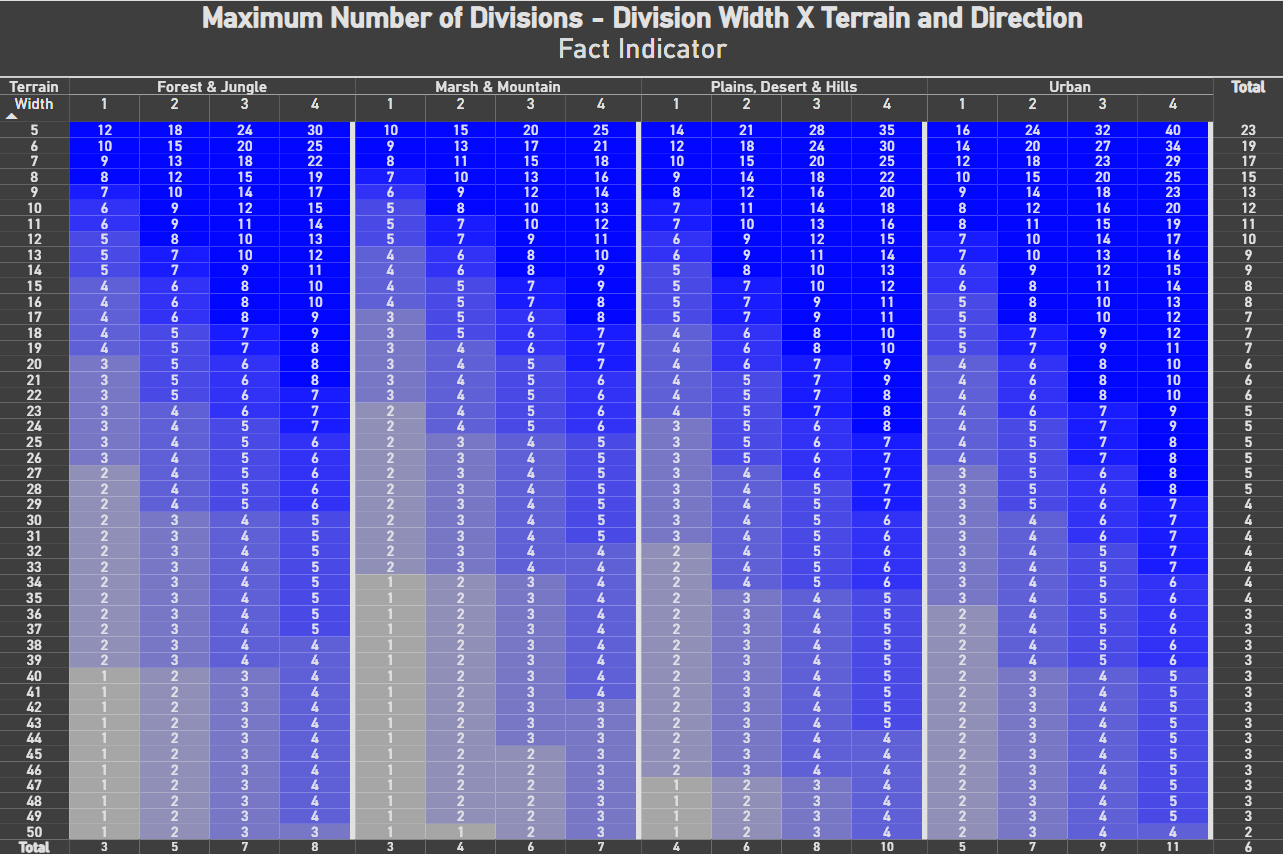
- Which division width fits best in each terrain (and why 14, 15, 18 or 25 show up so often).
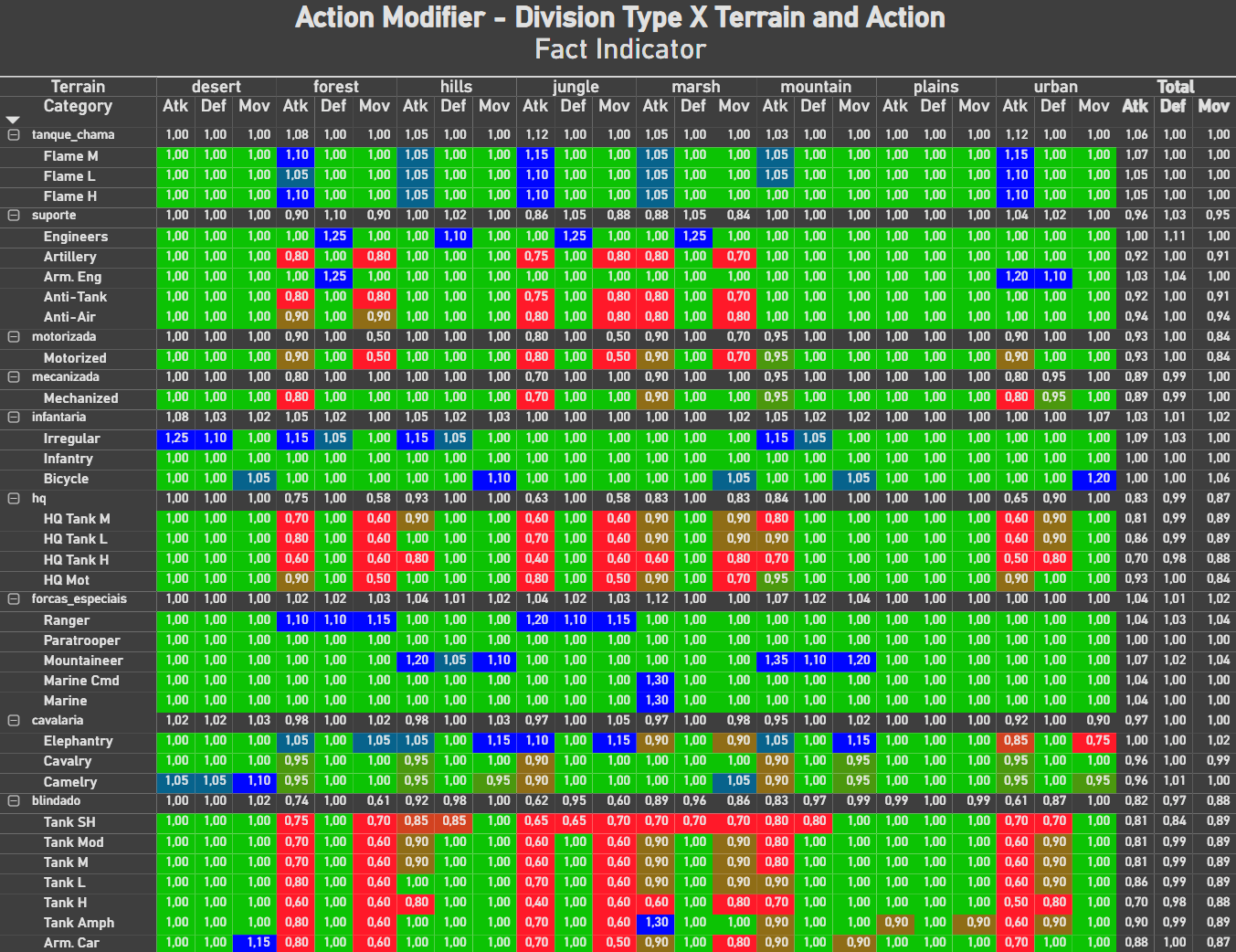
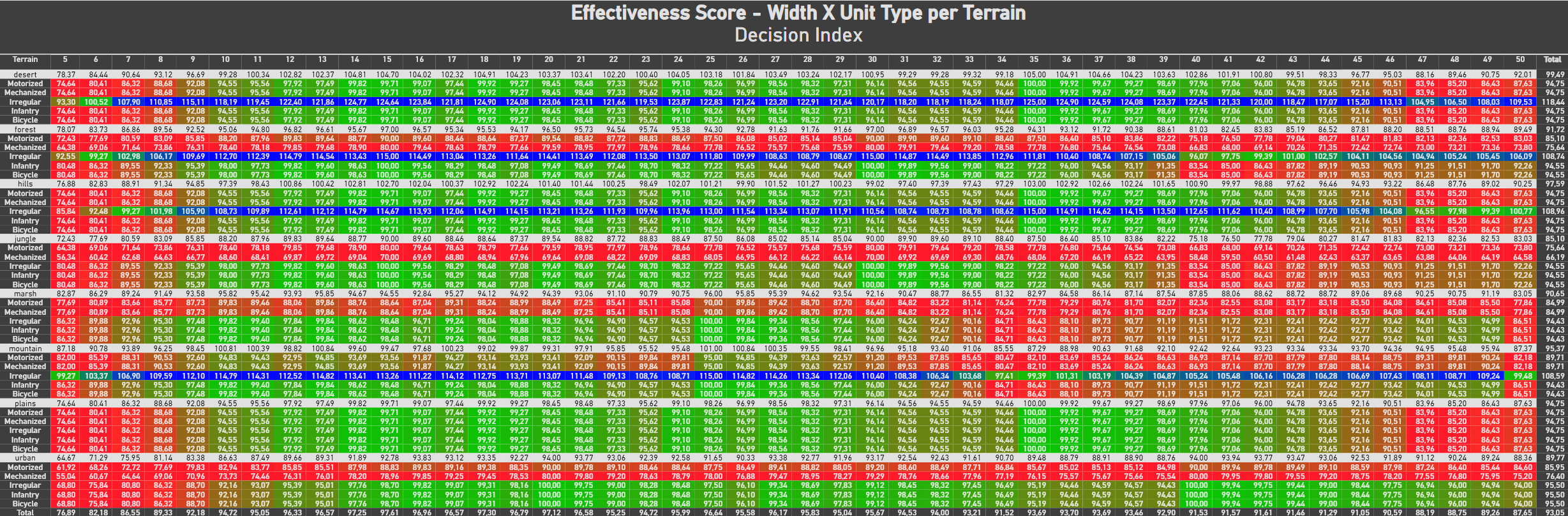
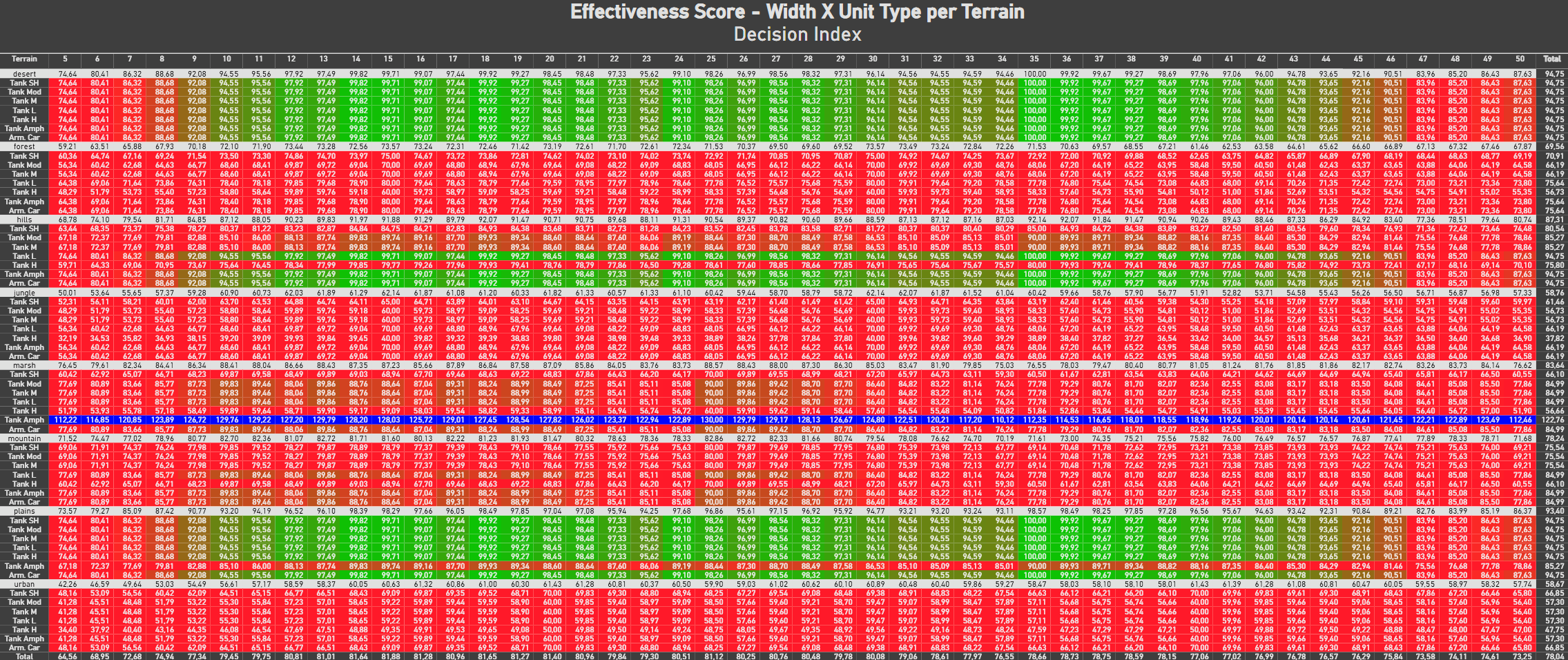
- How each unit type performs in each terrain — why armor struggles in the mountains and a mountaineer shines there.
- The cost of operating in each terrain outside of combat — attrition and supply, the logistics side almost nobody looks at.
Where the data comes from
The idea here is simple: give you (or anyone) a base to build divisions however you want, looking at what's good and what's bad in each situation — not to follow an exact meta. Nothing in the game is exact; the difference is in the effectiveness.
Every number comes straight from the game files (not from a wiki, not from memory), on version Operation Postern v1.19.1. Every value is traceable by file:line. Three files do the heavy lifting:
This data was placed into a star model (dimensions + facts). With it, I refined the data into separate tables:
- Fact = raw number extracted from the game (width, attrition, unit modifier). Those numbers point to a reality — that's why it's called a fact: "This costs 5 horses; if I buy it, I'll spend 5 horses!"
- Index = a calculation I built on top of that (Effective Score, Logistics Index). Where it's an index, it's marked as such — it's a model, not the game's absolute truth. "Right now it costs 5 horses, but two weeks ago it cost 3 — that's 20% inflation per week!"
Calculations, formulas and visions
- Overstack (excess): −1% per point of width that goes over, up to a −33% cap. Beyond that no more divisions join (reinforcement stops at 1.33× the width).
- Stacking (piling up): starting at 5 divisions in the combat, −2% per extra division, with +3 slack per attack direction.
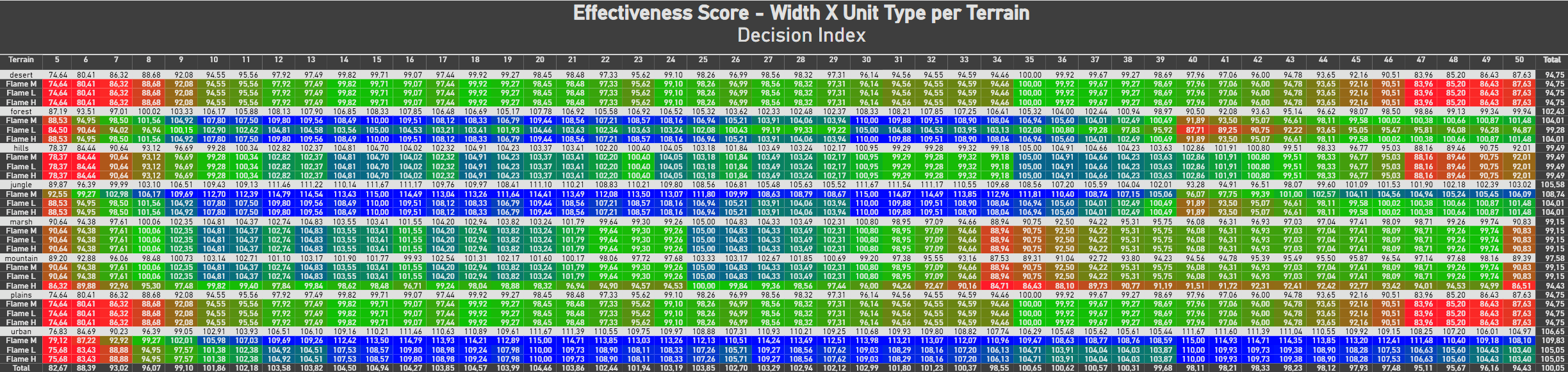
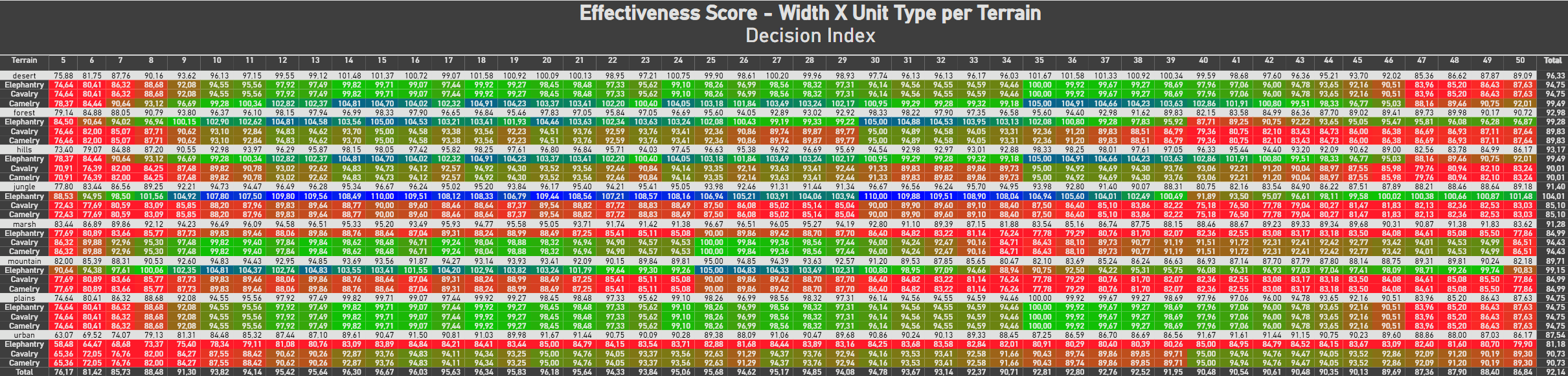
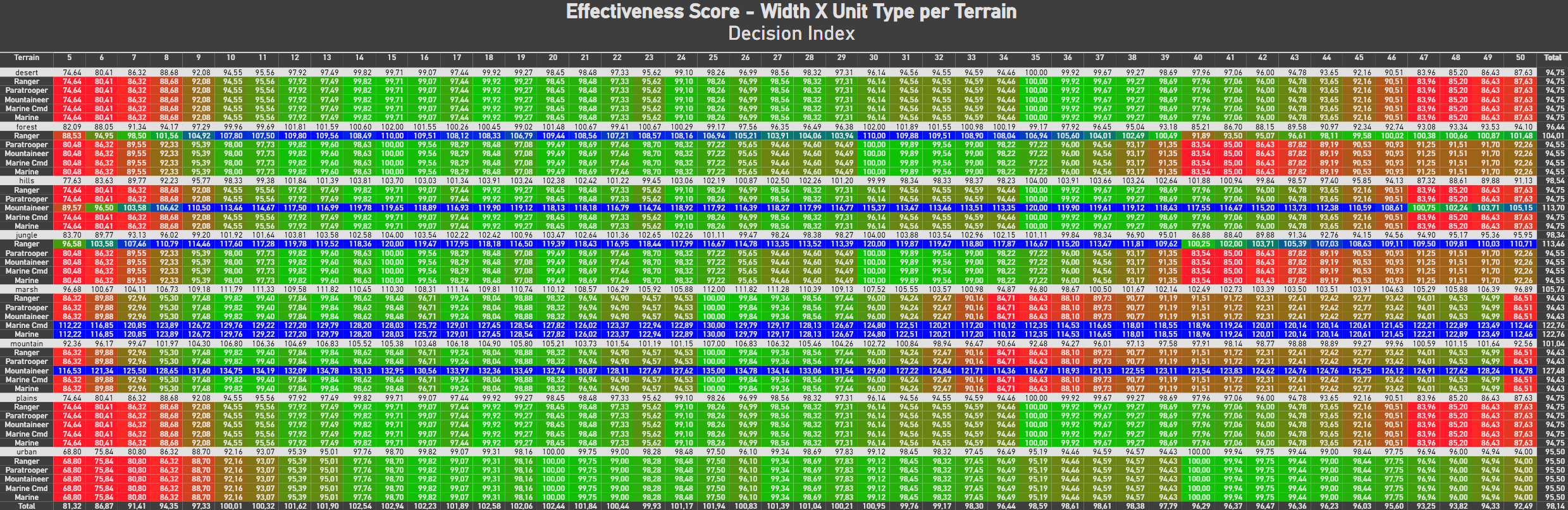
- Attrition — passive wear on the troops just from being/moving in that terrain (losing equipment without combat).
- Supply flow penalty — how much the terrain chokes the supply passing through it (negative = it helps, as with urban).
- Truck attrition — wear specific to the supply trucks; bad terrain burns your trucks (marsh/jungle are brutal).
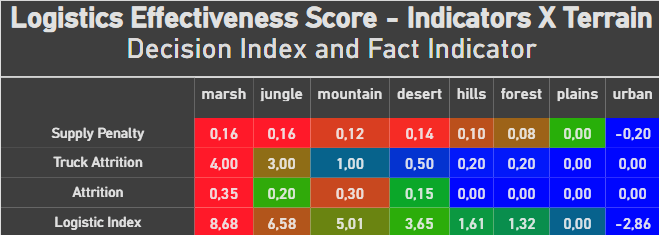
- The higher, the worse — more logistical pain. Marsh and jungle at the top; plains at the bottom.
- Urban goes negative (supply is a bonus there) — negative = terrain that helps logistics.
END
I'm Brazilian and I reworked this guide by putting it in English. So I might have translated something wrong.
And I only have around 117 hours played in HOI IV. It's not my intention to say what's right or wrong — it was never about that. I just got intrigued by how much division-building gets discussed in the community: "Which division is best?", "What's the 2026 META?"
Anyway, I had a lot of fun using my passion for Data Science — the same one I've used to survive in the world since 2020 — working on this game I'm so addicted to. I hope something good came out of this "guide": something you used to do without understanding why and now get, a question answered, or data and feelings carried into a more abstract world.
If a discussion comes up that makes sense, I'd love to bring more views and/or more data that hasn't been looked at/extracted from the game yet.
(I'll try to keep the numbers updated if anything changes in a future update!)
- Division Templates, Tank Designs, Aircraft Designs, and Metas (Bolivar 1.14+)★ 5 (3k)173k views8.7k ♥29 minUpdated Apr 30, 2025
- The Ultimate Guide to Division Templates, Aircraft and Tank Designs (Updated 15-06-2026)★ 5 (3.3k)134k views11k ♥54 minUpdated Jul 6
- Выполняем достижения в Hearts of Iron 4★ 5 (3.2k)69k views7.9k ♥326 minRussianUpdated Jul 19
- The Ultimate Guide to Navy; Ship Templates and Fleet Composition (Updated 24-3-2026)★ 5 (1.2k)61k views4.9k ♥33 minUpdated May 17
- HOI4. Большой гайд★ 5 (738)58k views2k ♥101 minRussian
- Лучшие шаблоны в HoI IV (1.15v.)★ 5 (612)49k views2.2k ♥6 minRussianUpdated May 20



- Upgrading to PremiumTeam Fortress 2★ 5 (20k)1441k views11k ♥6 minUpdated May 11, 2022
- No More Room in Hell Official ManualNo More Room in Hell★ 5 (2.8k)569k views2.1k ♥29 minUpdated Apr 22, 2019
- NMRiH Community Hosting GuidesNo More Room in Hell★ 5 (526)351k views653 ♥1 minUpdated Aug 10, 2022
- ULTIMATE GUIDE FOR GAME DEV TYCOONGame Dev Tycoon★ 5 (5.8k)326k views10k ♥4 minUpdated 23 Jan, 2014
- How to 'Git Gud' Soon™MORDHAU★ 5 (2k)318k views3k ♥68 minUpdated Nov 16, 2024
- Лучшие кооперативные игры SteamPAYDAY 2★ 5 (1.5k)315k views2.1k ♥56 minRussianUpdated Apr 27, 2025




This guide was created by its original author on the Steam Community. Are you the author and want it removed? Request removal.