Sustainable Pacu Ranching
Introduction
Long ago, Pacu farms used to be trivial to set up. Players could pack an indefinite quantity of Pacu into a single tile of water and make endless quantities of sustainable food. After the changes to ranching made in the Packed Snacks update (11/16/2023), that was no longer possible, and I set out to research the new mechanics and document my findings.
While many other methods of sustainable food production also exist, Pacu have long been one of the simplest and most effective to utilize, and you are likely wondering what you need to design a ranch of your own.
In this guide, I have provided all the important information you'll need to know to redesign an existing Pacu ranch, or to build a new one from the ground up. I'll also provide a ranch design that I created after experimenting with ranching Pacu that you may find helpful in designing your own.
However, if you want information on advanced concepts and theories, you might be better off looking for other resources, even if some of them might be deprecated. For example, Magialisk's guide to Fully Automated Infinite Pacu Ranching, while outdated, covers some advanced concepts I don't cover here, such as pathing restrictions and liquid stacking. Since the Packed Snacks update released, I have also seen content on YouTube covering other ranch builds and ideas, so you might consider seeking some of those out if that's of interest.
Important Mechanics
- Lay multiple eggs before its death, growing the population,
- Lay a single egg before its death, sustaining the population, or
- Lay no eggs before its death, decreasing the population.
As such, understanding what affects their happiness (and how that affects reproduction) is important to making a sustainable ranch.
Part of this information is sourced from the patch notes for the Packed Snacks update.[forums.kleientertainment.com]
- For breeder Pacu to grow a population, we need to keep their happiness at 4 or higher.
- If we want starved Pacu to lay an egg before death, we need to keep their happiness at -9 or higher to avoid them becoming miserable.
- Tame (-1): Tamed Pacu innately have -1 Happiness.
- Ate from Feeder (+5): Pacu that have consumed food from a feeder in the last two cycles gain +5 Happiness.
- Cozy (+1): Pacu that have used the Aquatic Fort building in the last cycle gain +1 happiness.
- Confined (-10): Pacu that are in fewer than 8 tiles of liquid (or flopping around outside of liquid) get -10 happiness and -100% reproduction rate. Importantly, this reproduction penalty remains even if happiness is above -10.
- Crowded (-X): Has a slightly more complex happiness affect, and I will cover it in detail below.
If you didn't read the above list thoroughly, let me be clear: NEVER PUT PACU IN 7 TILES OF LIQUID OR LESS IF YOU WANT THEM TO LAY EGGS. Even if their happiness is increased through feeding, they will not lay eggs while confined.
- Every 8 tiles of liquid in a pool provides space for one Pacu to be comfortable.
- If there are more Pacu in a pool than would be comfortable, all of them become Crowded.
- Pacu get -1 happiness from Crowded for each Pacu in excess of the comfortable ratio.
- Pacu can't be Crowded if they are already Confined (in less than 8 tiles of liquid).
As a side note before we move on, you can use the Aquatic Fort in 9 tiles of liquid to increase the starved Pacu limit to 10, although it's usually not going to be as space efficient, and I didn't end up doing this in my design.
- Using multiple, smaller tanks is more space-efficient for starvation ranching, but always use at least 8 tiles of liquid per tank. 9 Pacu can fit into an 8-tile tank for the optimal starvation tank size.
- Pacu in breeding tanks can't be crowded, so use 8 tiles of liquid per Pacu as was the case before the update.
- The Aquatic Fort building can be used to squeeze an extra Pacu into the same space, for both starvation or breeding tanks, while still allowing egg production.
- Pacu can consume 7.5kg/cycle of Algae, which is less than alternative uses on its own but can burn through your algae supply if you're feeding a lot of Pacu.
- Pacu can consume 1kg/cycle of seeds (1 seed = 1kg), providing a good alternative to algae as well as making them a decent way to dispose of excess seeds.
- Pacu don't include decorative seeds, such as Bluff Briars, in their diet, so you don't have to worry about accidentally feeding them nonrenewable seeds.
Ranch Design
Here I've included the blueprints for the ranch I designed after the Packed Snacks update released. You are free to use these as a reference to build your own, or adapt them to your own needs. The concepts I've provided here, as well as the reference material, are free for you to use as you see fit.
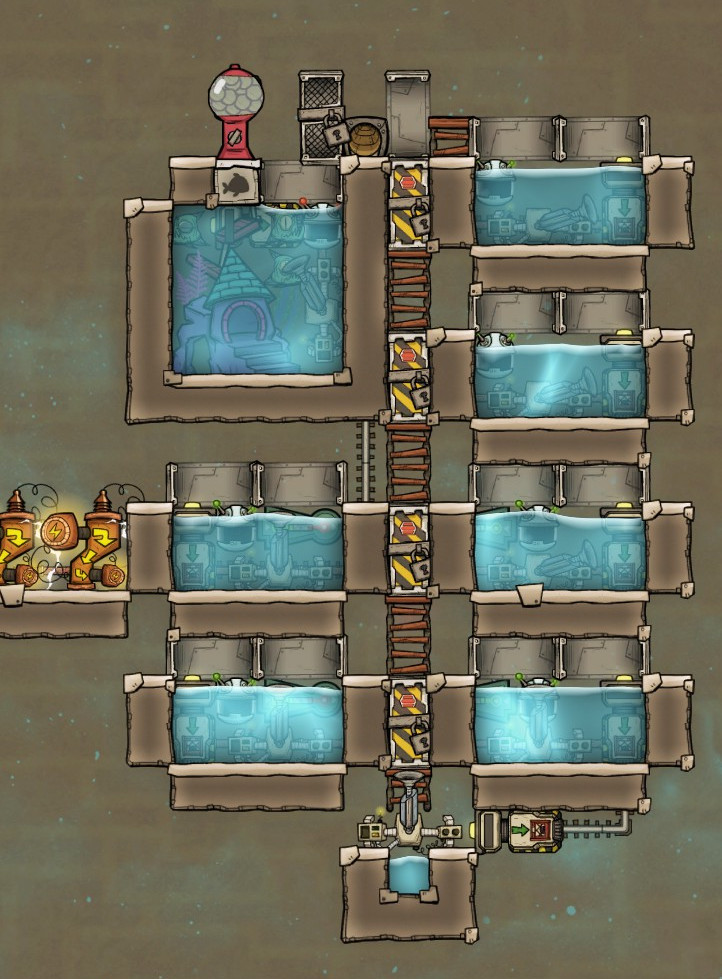
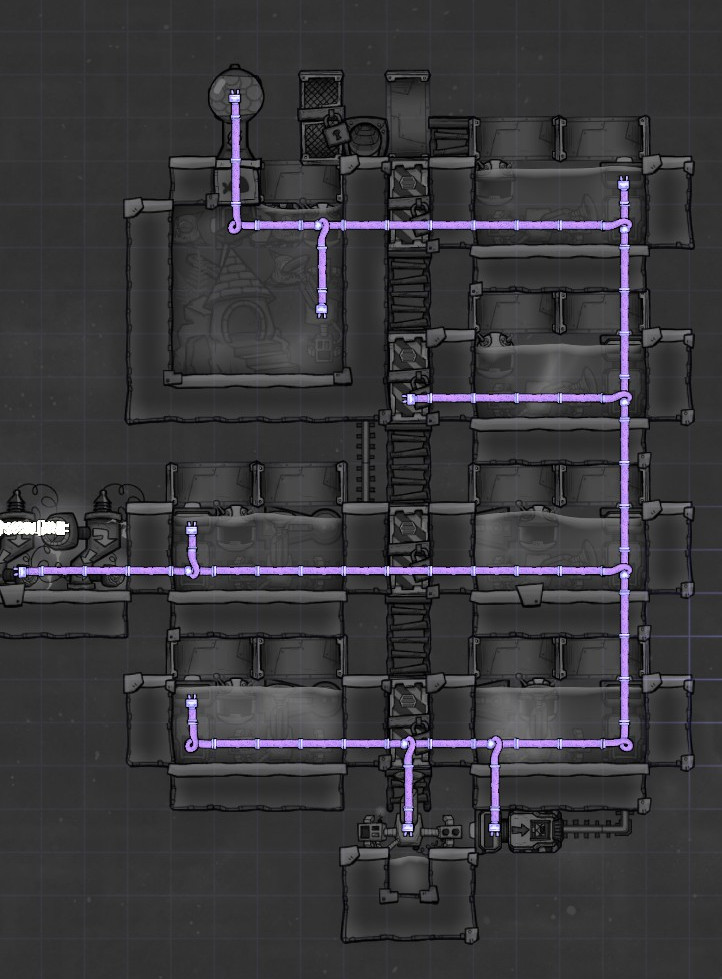
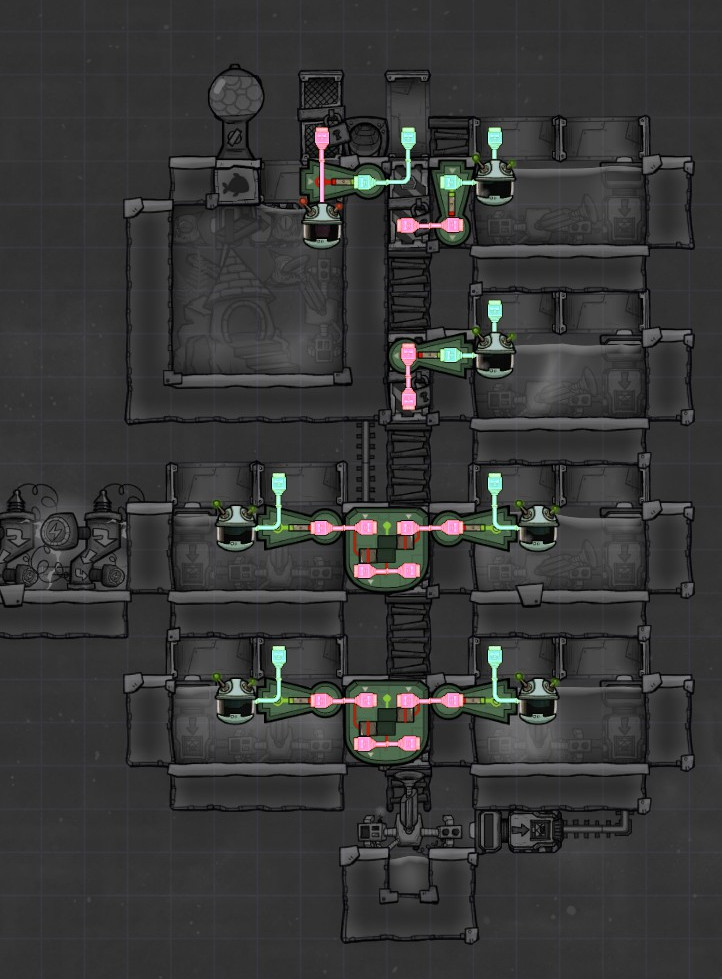
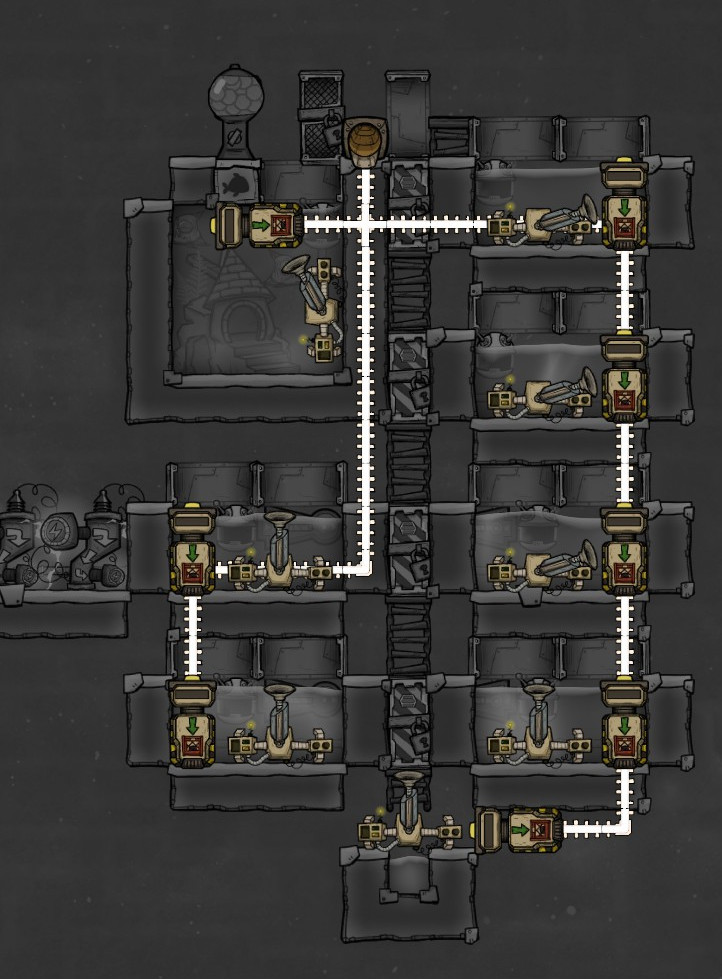
- A sweeper and loader for the eggshells, polluted dirt and Pacu Fillet is not included in the diagram. Add those in range of the Conveyor Chute at the top to pipe them to your kitchen for grilling, or elsewhere as needed.
- This design can be stacked vertically, and you can add as many more starvation tanks below as you want, copying the bottom half as many times as desired. Each starvation tank provides enough kcal per cycle in cooked seafood for about half a duplicant.
- The Critter Sensor is set to send Green if below 3. Critters are counted, eggs are not.
- The Conveyor Loader accepts Fry Eggs, Gulp Fry Eggs, Tropical Fry Eggs, Pacu Fillet, and (optionally) Polluted Dirt - you may not want the polluted dirt collecting wherever you're sending the Pacu Fillet and Eggshell, and it won't emit polluted oxygen while in the breeder tank.
- The fish feeder can be filled with fish food of your choice.
- All of the starvation tanks have the same configurations:
- The Critter Sensor is set to send Green if below 9. Critters are counted, eggs are not.
- The Conveyor Loader accepts Fry Eggs, Gulp Fry Eggs, Tropical Fry Eggs, and Pacu Fillet.
The breeding tank has a capacity of 3. You can build a larger one if you want or need it; I chose this size because it fits in well with the vertical starvation tank arrangement.
If there are fewer than 3 Pacu and/or eggs in the breeding tank, access to the starvation tanks is blocked off, and the breeding tank is opened to allow delivery of another Pacu.
Similarly, when each starvation tank has 9 Pacu and is at capacity, access to the tank is blocked off so that Pacu will navigate to other nearby tanks instead.
If both tanks on a level are full, the door in the middle opens to allow Pacu to drop down to the next layer. This can repeat for as many tanks as you want, as long as the Pacu can all fall down one main shaft.
When all the tanks are full, any excess Pacu that hatch will fall into the excess pit at the bottom of the ranch. These extra Pacu won't lay eggs since they're confined, and can be freely killed or relocated by hand if you need their fillet early. Otherwise, they will starve and die on their own timeline.
The pneumatic doors covering the tanks are necessary for the critter sensors, so they only detect pacu in their tank and don't pick up critters in a larger room. If you wish, you can replace the outer doors with tiles; I chose doors as it allows for easier duplicant access.
Conclusion
Hopefully you now have everything you need to make a proper ranch to support your colony. Whether you're simply feeding your Duplicants the Fillet, using it to make more potent foods like Surf'n'Turf, or you're using it in a more creative or unusual way, Pacu have been the backbone of many a colony's food supply, and now they can be for yours too.
Happy fishing, and best of luck with your colony!
If you found this guide helpful, consider rating it!
- ONI - Surviving the Early Game★ 5 (2.4k)83k views6.3k ♥54 minUpdated Aug 6, 2019
- Useful Construction Patterns★ 5 (1.8k)74k views5.2k ♥66 minUpdated Aug 29, 2020
- Compendium of Amazing Designs★ 5 (2.9k)66k views6.5k ♥77 minUpdated May 29, 2025
- 10* things I wish I knew sooner...★ 5 (754)58k views1k ♥4 minUpdated Oct 6, 2017
- ONI - Surviving the Mid-Game★ 5 (1.3k)44k views3.8k ♥150 minUpdated 6 Sep, 2019
- Not Quite Beginner's Guide★ 5 (361)32k views1.1k ♥91 minUpdated Mar 26, 2023




- Upgrading to PremiumTeam Fortress 2★ 5 (20k)1441k views11k ♥6 minUpdated May 11, 2022
- No More Room in Hell Official ManualNo More Room in Hell★ 5 (2.8k)569k views2.1k ♥29 minUpdated Apr 22, 2019
- NMRiH Community Hosting GuidesNo More Room in Hell★ 5 (526)351k views653 ♥1 minUpdated Aug 10, 2022
- ULTIMATE GUIDE FOR GAME DEV TYCOONGame Dev Tycoon★ 5 (5.8k)326k views10k ♥4 minUpdated 23 Jan, 2014
- How to 'Git Gud' Soon™MORDHAU★ 5 (2k)318k views3k ♥68 minUpdated Nov 16, 2024
- Лучшие кооперативные игры SteamPAYDAY 2★ 5 (1.5k)315k views2.1k ♥56 minRussianUpdated Apr 27, 2025






This guide was created by its original author on the Steam Community. Are you the author and want it removed? Request removal.