Basics For Beginners
Introduction
The Basics, Pt 1: Outline
The Basics, Pt 2: Cities
Cities are the most important part of your civ. Each one produces several things that contribute to your civ as a whole or to that city in particular. This section covers city-specific things. Civ-wide things are under Empire Management.
Production: Production is the most important part of any city. Every city has a production output of so many 'hammers' per turn. The hammers are used to build building or units. Units will be covered later. Buildings are specific constructions, such as libraries, granaries, aquaducts, and factories, that somehow enhace your city. Each building provides a different bonus. Some contribute to research, culture, production, and gold, while others increase the city's ability to withstand attacks. Each building has a production cost, the amount of hammers needed to build it. All the hammers your city produces in one turn go to the building that turn at the start of your turn. That last part is important for units and Wonders.
Food: People gotta eat, yo. Food is used to feed the citizens of your cities, and excess food goes to increasing population. Few buildings increase food, so tile improvements (see the Land section) are needed to keep your cities growing. Excess food must reach a certain cumulative sum to enlarge the city, meaning it can take a few turns for cities to grow.
Local Happiness: I'll cover this in more detail in the Empire Management Section. This only matters based on Unhappiness. If a particular city is too unhappy, wierd ♥♥♥♥ starts happening. It may even revolt and join another civ.
Border Expansion: Better titled "Local Culture," a city's culture output determines how long it is between border expansion. This is more important to Land.
Great Person Points: For now, just know that's a city specific thing. I'll cover Great People later.
The Basics, Pt 3: Land
Land is the tiles under your control that are not cities. Each tile has two parts: features and resources. I'll cover features here, Resources have their own section. Tiles are worked by citizens of a nearby city who are not employed in the city. The following are the yields of every type of tile.
Grassland: most common tile, produces two food.
Plains: Second most common, produces one food and one production.
Desert: Without a certain Wonder or floodplains, produces NOTHING.
Tundra: Produces one food, found near the top and bottom of the map.
Snow: Like Desert, but less common. Found closer to the top/bottom than Tundra.
Coast: Produces one food without a Lighthouse (building), two with.
Ocean: Same as coast.
Marsh: Produces one food, slows units down.
Features:
Hills: Can be found anywhere on land (except marshes). Instantly converts the output of the tile to two production.
Forests: Can be found on Tundra, Plains, and Grasslands. Adds one production, one food if a Tundra tile. Can also have Hills. Slows units down.
Jungles: Can be found on Grasslands only. Does not change output unless the nearby city has a university, at which point it adds two science. Can have Hills. Slows units down.
Rivers: Don't do much. They can become VERY important with the right buildings and techs. At best, adds one production per tile with a River and one food for farms (Improvement, see next section). Units stop moving after crossing a River.
Floodplains: Makes Deserts useful by adding one food.
Lakes: Coast, but not a Coast.
Atoll: Important to Japan, useless otherwise. Produces two food.
Mountains: ♥♥♥♥ you, this tile is now completely useless (with two exception for Wonders). Units cannot cross Mountains.
Fallout: Only found after someone uses a nuke. Slows units down, halves outputs (never less than one).
The Basics, Pt 3.5: Improvements
How to make Land be awesomer. Must be built by a Worker unit (see next section.)
Farms: Built on Plains, Grasslands, and Floodplains. Adds one food, improved with tech.
Mines: Built on Hills or certain resources. Adds one production, improved with tech.
Pastures: Improves specific resources. Adds one production.
Lumbermills: Built on Forests. Adds one production.
Quarries: Mines, but on different resources.
Plantations: Improves certain Resources, especially Luxury Resources. Adds one gold and one food.
Trading Posts: Built anywhere. Adds one gold. Improved to one science and three gold with techs.
Roads: Built anywhere. Connects cities, allows units to ignore terrain movement costs (and move
faster). Costs gold to maintain, but provides gold by conecting cities to the capital.
Railroads: Built anywhere. Costs twice as much as Roads to maintain, but gives units twice the speed and provides production to cities connected via Railroad.
Fishing Boats: Water specific, requires Work Boats. Only built on water resources. Output varies, but at best is at least two food, two gold, and one production.
The Basics, Pt 4: Units
Military basics are later, this is the bare bones.
There are two kinds of units: Civilians and Military. Civilian Units are Great People, Workers/Work Boats, Religious Units, and Settlers. Civilian units cannot defend themselves, but can stack with Military units.
Settlers: Found cities.
Workers/Work Boats: Improve tiles. Workers have infinite uses, Work Boats have one use.
Great People: See that section(s).
Religious Units: Spread religion. Ignore borders.
The myriad Military unit types will be covered later.
Research
Turn 1
For first production, you can either build a Monument to produce Culture (see Empire Management) or any of the initial units. Scouts are the only viable alternative to building a Monument.
Empire Management: Intro
Empire Management: Culture
Look at you, uncultured swine, with only one Culture per turn at Turn 1! Don't worry, we can fix this later. For now, what is Culture? Culture is the currency used to purchase Policies. Policies are small bonuses to your empire that must be gotten sequentially. There are nine Policy Trees. Each has five Policies. It takes six Policies to complete a Tree (one to open the Tree for further use). Adopting all five gives you a significant bonus, while simply opening the Tree gives a small bonus. Culture is produced each turn, but used all at once in a cumulative total. It is impossible to produce negative Culture. Each subsequent Policy is more expensive, and cities increase the cost of Policies. Each Tree is easily summed up.
Tradition: Have four really good cities. The rest are fluff.
Liberty: Have a lot of cities. A LOT. Of cities.
Honor: Culture from Barbarians, and other small military bonuses.
Piety: Produce all the Faith (see Religion).
Patronage: All your City-States are belong to us (see City-States).
Aesthetics: Culture is the only thing that matters.
Commerce: Land based trade routes (the picture lies, see Trading) and bonus from gold buildings.
Exploration: Rule the seas. Hope no one launches a land invasion.
Rationalism: SCIENCE!
Ideology: Covered in that section.
Empire Management: Gold
Empire Management: Happiness
Empire Management: ♥♥♥♥♥♥♥ Barbarians
Resources
Luxury Resources
Strategic Resources
What good are Horsemen without Horses? Strategic Resources (often shortened to Strat Resources) are required to build certain units, which tend to be stronger than the units not requiring Strat Resources. The are six Strategic Resources (listed in order of revealing by techs):
Horses: Horses are needed to build any unit that needs Horses. If that sounds like a dumb explaination, it's because there is no better one. Horsemen, Knights, Cavalry, and Lancers all need horses, and all are depicted as being mounted units. Revealed by Animal Husbandry. Fairly common.
Iron: Needed for Swordsmen, Longswordsmen, and... Frigates. Swordsmen are self-explanatory, and Frigates are the mid-game ranged navy unit (see Military). Revealed by Bronze Working. Moderately common.
Coal: Needed to build Factories (which are buildings) and Ironclads. Don't bother with Ironclads, build Factories: they increase hammer production by a lot and allows you to get an Ideology (see that section). Revealed by Industrialization. Uncommon.
Oil: Needed for Battleships, Tanks (and Landships, but Tanks), and most Air Units (see Military). Incredibly valuable late-game resource. Revealed by Biology. Depending on the number of Deserts, either Ultra common or Fairly rare.
Aluminum: Needed for Modern Armor, Jet Fighters, Stealth Bombers, Hydro Plants (building) and Spaceship Factories (building, see Science Victory). If the game lasts into the Information Era (the very late game), there is never enough of this stuff to go around. Can be provided by buildings (as much as ten, from five Recycling Centers). Revealed by Electricity, which can be before Biology. Uncommon.
Uranium: Needed for Atomic Bombs, Nuclear Missiles, Nuclear Reactors (building), and Giant Death Robots. The last one is censored due to shock value. Uranium is the rarest Strat Resource, and by far the most valuable. Having nukes changes the nature of the game. Do not be afraid to fight wars over Uranium. Revealed by Atomic Theory, Ultra rare.
Foreign Relations
Coming back to your first game, this is probably around turn 30. You have met another civ! Cool! They might have stuff you don't! Here's how to maximize your diplomacy:
Declaration of Friendship: Under the Discuss tab. Creates an alliance.
Denuciation: Makes an enemy. Under Discuss.
Embassies: After both sides get Writing, you can establish embassies, required for anything more than swapping Resources and Gold.
Open Borders: Requires embassies. Allows units to freely enter the territory of the giver of open borders. Friendly civs ask for this as a matter of course.
Research Agreements: Once one side has Education, both can pay Gold to get a Research Agreement. After so many turns, both sides get a huge boost to Research. Must be re-established after every use, only usable with Allies.
Defensive Pact: If one civ is attacked, the other joins the war. NOTE: THIS DOES NOT APPLY IF ONE IS THE AGGRESOR. BEING THE AGGRESSOR IN A WAR ENDS THE PACT.
Trade Cities: Requires Embassies. What it sounds like, but normally done to end wars (see Wars).
Make Peace With/Declare War On: The giver of this does that to the named civ or City-State.
All of this can be found either by clicking on one of the other civ's cities or through the diplomatic menu (top right), then clicking on the civ there.
Under the Discuss tab is all kinds of cool stuff to shape your relations. Be sure to check that out.
City-States
No, not Venice. (for context, that's a joke among the community). City-States are minor players in the game. They cannot build Wonders, establish second cities, adopt Policies, or found Religions (see Religion). City-States are allies of whoever gives them the most money. If this sounds useless, Patronage makes City-State allies more valuable than your own cites. Even without Patronage, City-State allies give you extra votes in the World Congress (see that section and Diplomatic Victory), and their Lux and Strat Resources, plus a bonus dependent on what kind of City-State it is. The bonuses are:
Maritime: Food to all your cities, just your capital if Friends.
Mercantile: Free Lux Resource otherwise unattainable.
Religious: Faith.
Cultured: Culture.
Militaristic: Friends give you various units, Allies give you Unique Units that come from other civs. This is how British Minutemen exist.
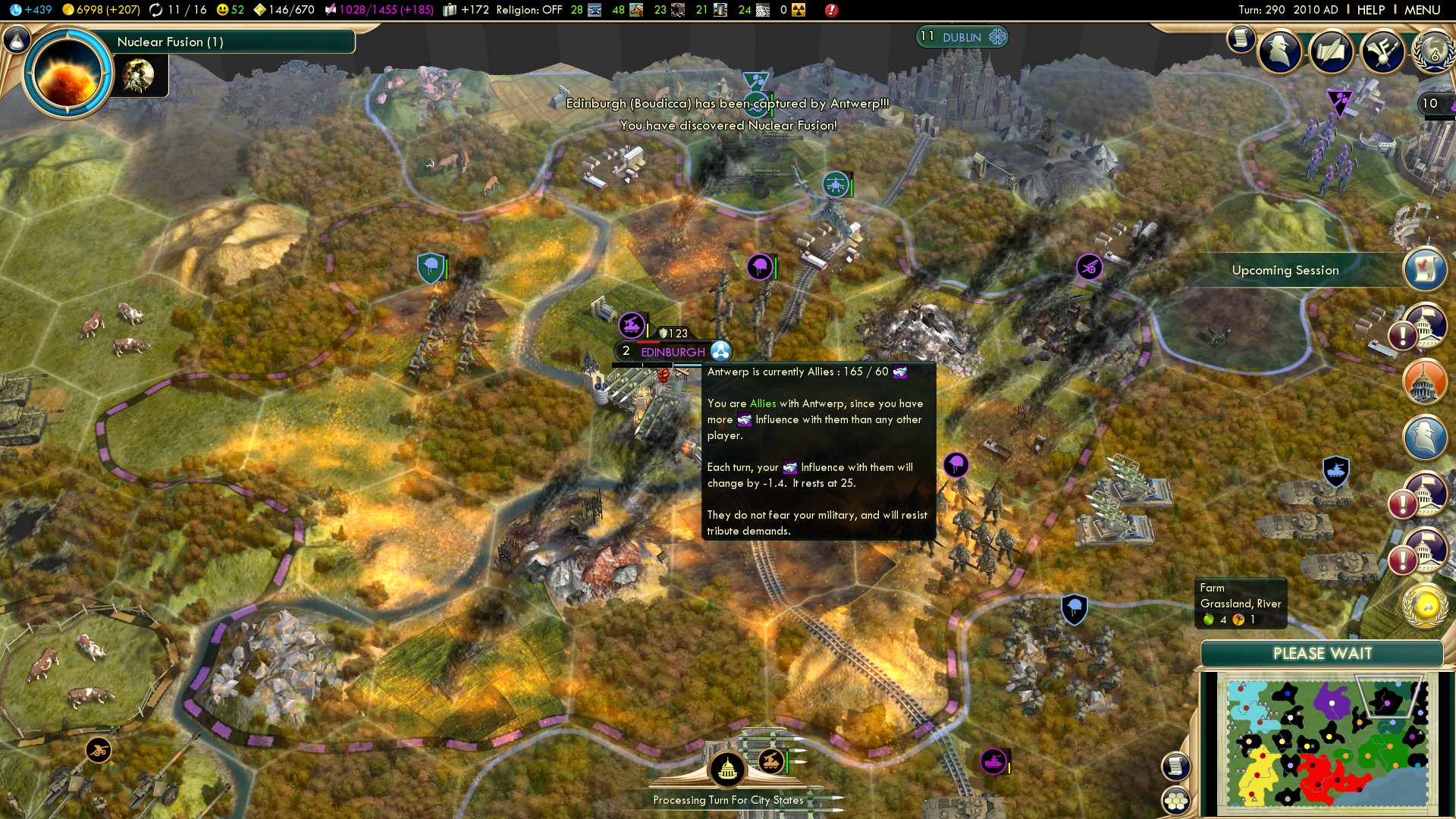
As you can see, City-Staes are badass. Not to mention, if you go to war (see War), all your City-State allies come with. It doesn't matter most of the time, but I have seen City-State capture capitals before (see image).
A Return to the Homefront
Now that we have covered most of your interaction with other civs, let's discuss the basic strategies for building an empire. Make sure you have Workers improving tiles (there is an auto-improve command in the same place we found explore on Turn 1). Unless you're Venice, build at least four cities (especially if you have Liberty). If you are Venice, work on getting those trade routes up and running (see Trading). Adopt Policies that are in-line with advancing your goals. Note: Patronage and Aesthetics are really there for certain victory types. Both are versatile, but remember that the others are more generalized.
You should also be thinking about techs. If you have yet to enter the Renaissance Era, think about what techs you want to have when you do and what tech you want to use to enter the Renaissance.
You should also consider your military. One unit per city, or two for empires with less than four, or five for Venice, is enough to keep even the most aggressive civs away. Make sure you upgrade your units when possible, and ensure you have a diverse army to avoid overspecialization (see Military). If you can build your UU, build a lot of them. Most of the time, their bonuses carry over after upgrading, and they can't be built after you research the upgrade unit. If you want a military to conquer, see the Military section.
Keep an eye on your production levels. One Policy every ten to fifteen turns is the best, and techs should only take more than ten turns if they are more than two columns further than the other techs you have (this makes more sense if you look at the Tech Tree). Gold should probably be at about 40-60 GPT entering the Renaissance, more if you have a large empire or are Venice.
Religion
Religion is spread by Missionaries and Prophets, who are moved to a tile adjacent to a city and the spread religion. Inquisitors, when placed in cities, prevent this.
Great People
Great People are unique civilians who do great things. There are several kinds.
Great Scientists can be used to discover the tech you are currently researching or to build an academy, providing a permanent +8 Science boost.
Great Engineers can be used to rush the production of any Wonder or building in a city, or to build a Manufactuary, providing a permanent +6 hammer boost.
Great Prophets, in addition to their already discussed abilities, can build Holy Sites, providing +2 Faith.
Great Admirals and Generals provide a combat boost to surrounding units. Admirals can repair every adjacent unit and Generals can build Citadels, providing a huge defensive bonus to any unit on that tile.
Great Merchants can conduct Trade Missions with City-States, giving a large Gold and Influence boost.
Great Artists, Musicians, and Writers can produce Great Works, giving a Tourism (see Cultural Victory) bonus. Artists can also start a Golden Age (increased everything), Musicians can do a conert tour in other civ's territory (adds Tourism), and Writers can produce a Political Treatise, giving huge Culture amounts.
Great People are earned through Great Person Points (GPP). Specialists and certain Wonders increase your GPP per turn.
Sidebar: Venice
Trading
Wonders
What if we had buildings, but they were like, super buildings?
We do. They're called Wonders.
Wonders are that simple: really awesome buildings. Normally, their benefits are empire-wide rather than city-specific. Every Policy Tree has an accompanying Wonder for opening the Tree, and there are countless others. I will allow you to decide what Wonders matter to you, but here are some that are always useful.
Alhambra: 20% Culture from this city. All applicable units built in this city get Drill 1 (a promotion increasing fighting bonus in Rough terrain, see Military). Free Castle (building) in this city.
Sistine Chapel: +25% Culture from all cities. Contains two slots for Great Works (see Cultural Victory).
Leaning Tower of Pisa: +25% Great Person generation in all cities (see Great People). Choose a GP upon completion.
Brandenburg Gate: +15 Exp for all units built in this city (see Military). With this and all the other Exp buildings, units can get three free promotions out the gate. Especially powerful when paired with Alhambra.
Great Firewall: Essentially prevents Spying (see Spying) in this city, 25% reduction in Spy Potential in other cities.
CN Tower: +1 food and +1 Happiness in every city. Free Broadcast Tower (building) in every city.
There are many more, these are just the ones I like the most.
Ideology
After building three Factories or entering the Modern Era, you can adopt an Ideology. These give huge boosts to whatever they focus on.
Freedom gives bonuses to Culture and Happiness. Its Wonder, the Staute of Liberty, makes every Specialist (citizen working in a city) give +1 hammer. Most of Freedom's bonuses are indirect: they'll boost something seemingly irrelevant, but that something is related to something important. The hardest Ideology to really understand and use effectively.
Order is about Happiness, Science, and hammers. Its Wonder, the Kremlin, increases production speed of Armor units by 50%. Order is the most straightforward: direct bonuses and clear wording. For your first game, Order really isn't a bad choice. Its main drawback is its Wonder, which isn't as good as the other two.
Autocracy is about conquering the world. One Tenet gives double of all Strat Resources. Its Wonder, Prora, gives +1 Happiness for every Policy you've adopted. Autocracy can be the weirdest one to use. It doesn't really give bonuses to anything other than military stuff, and is easily the least versatile of the three.
Ideologies are powerful, and divisive. Allies will go to war over differing ideologies. Freedom and Autocracy also give bonuses to City-State relations.
Military, Pt 1: Outline
This is it, the part I've referenced so many times. We're here. To begin, your military is made up of units that belong in two of four categories (this is WAY oversimplifying, but more detail is later): Either Land or Navy, and Melee or Ranged. These four labels are self-explanatory. Note: Ranged units with a range of 1 tile are still Ranged, just with the attack radius of a Melee unit. There are more categories than this, but those are later in this section.
The basics of Military Units are based on one thing: Strength. Every unit has one. This value determines which unit wins a battle. There are two kinds of Strength: Ranged Strength (RS) and Melee Strength (MS). MS is how well the unit performs in melee combat. Ranged units have very poor MS, while Melee units have good MS. RS is for Ranged units only. When performing a ranged attack, RS is weighed against the target's MS (sorta. It's way too complicated for anyone to explain.). Ranged Unit's use their RS when being fired upon (sorta). More advanced units have higher Strength.
Let's examine the more specific subtypes.
Military, Pt 2: Melee
The basic units of any fighting force. Melee units come in two flavors: Gunpowder and pre-Gunpowder (actually called Melee, which is confusing.)
Pre-Gunpowder units are any Melee unit not using guns. One civ (the Zulus) get bonuses to this kind.
Gunpowder units are Melee units using guns (everything after Musketmen). No one gets bonuses to this type.
Oh, and there's a few subtypes. (Not Mounted, those are a separate section).
Anti-Armor/Anti-Mounted: Units designed to fight the Mounted and Armor units. They get a 33% (I think) bonus against those unit types. Units in this subtype include Spearmen, Pikemen, Anti-Tank Guns, and Helicopter Gunships*.
Anti-Air: The AA Guns and Mobile SAMs are unique in that they can intercept Air Units (see Military: Air Units). They have a low MS, but get a 100% bonus when intercepting or fighting Helicopters*.
Scouts: Scouts aren't meant for combat, but are Melee units.
Paratroops: Can Air Drop up to nine tiles away, starting in friendly territory. You must be able to see the target tile.
Most of the units in your army should be these guys.
*Helicopter Gunships are Helicopters, a specific unit type that gets a bonus against armor while suffering a penalty against Anti-Air.
Military, Pt 3: Ranged
Ranged units attack units in tiles without actually meeting in combat, unlike Melee units. Ranged units have three types: Archers, Guns, and Seige Engines.
Archers are Ranged units that use bows and crossbows. They tend to have a range of two tiles.
Guns are Ranged units after Industrialization. Their RS goes way up, but only have a range of one. Gatling Guns, Machine Guns, and Bazookas are the three Gun type units.
Seige Engines get a 200% bonus versus cities, but must set up before firing (except for the late game Rocket Artillery). Seige Engines have two subtypes:
Artillery Seige Engines have a range of 3 tiles, can fire at units they can't directly see (as long as one of your units can see the target), and the Rocket Artillery doesn't have to set up to fire.
Pre-Artillery Seige Engines must be able to see their target, have a range of two (meaning cities can hurt them, see War).
Ranged units are meant to support your Melee units from the rear echelon. They also are good for defending against invaders. Most Ranged units have a low MS, making them vulnerable to direct attacks. It could be argued that Air Units are Ranged units, but I have separated them for clarity.
After you get Artillery, all your Ranged units should be Artillery. Guns just aren't useful enough to justify keeping them (unless they're upgraded from English Longbowmen, giving them a range of two).
Military, Pt 4: Navy
Navy units are good for when you have many coastal cites, and everyone else has a fair number of coastal cities. There are four kinds of Navy units.
Ranged Navy units act like Seige Engines in the late game and Archers in the early game. Frigates are the transition. Most Ranged Navy units require a Strat Resource of some kind.
Melee Navy units are for taking cities and guarding your Ranged Navy units. In the late game, they are used as Submarine hunters.
Submarines are Ranged units that are invisible to many Navy units except Destroyers and other Submarines (and maybe Missile Cruisers, help me out on that one). Submarines get a bonus for firing when undiscovered. They are visible after attacking or when adjacent to another unit. Submarines are good for attacking Cargo Ships, unescorted troop convoys, and navies with the misfortune to lack the tech needed to see Submarines.
Aircraft Carriers are for carrying Air Units (except Stealth Bombers). Carriers have very low Strength, cannot directly attack other units, a sight radius of one, and cannot see Submarines. They can intercept Air Units (see Air Units), and of course transport them.
Some civs are reliant on their navies to succeed in conquest. The AI is bad at making navies, so if you need a way to win a war, a navy is a good way to go. Be warned, however, that until you discover Astronomy, Navy units cannot cross Oceans*. Navies can at least partially replace armies, and if you have any major coastal cities, a few Submarines and Destroyers aren't a bad idea.
*Yes, Polynesian embarked units can always cross oceans, but their Navy units are still restricted.
Military, Pt 5: Cavalry
Cavalry is a name I use because Mounted is only half the story. Cavalry units are the heavy Melee units. Cav is good for breaking through enemy lines to wreak havoc in their homeland (see War for details), and for holding a line. They have a higher MS than Melee units, but Anti-Mounted/Anti-Armor counter them. They also suffer a 33% combat penalty versus cities. There are two types of Cavalry.
Mounted units are anything with Horses. They are slightly faster than Melee units, but cannot move after attacking until Cavalry (the Unit, yes I'm sorry). Interstingly, the Lancer is both a Mounted and Anti-Mounted unit. Use this knowledge wisely.
Armor units are Tanks and their cousins. Faster than Mounted units, they can move after attacking. Armor units are not effected by Anti-Mounted bonuses, it takes Anti-Armor to hurt them.
All Cavalry units require some kind of Strat Resource, starting with Horses, then Oil, Aluminum, and Uranium*. Cav is a good thing to have if you plan on having a large air force later (I'll explain this in War: Blitzkrieg). Do not over rely on Cav, as there are units specifically to counter it. Cav also suffers in terrain with high movement costs, limiting its mobility.
*It is not recommended that you use Uranium for this unit. It's better for nukes.
Military, Pt 6: Air Units
If the game has lasted long enough for Air Units to come into play, they will decide who wins the Dom Victory (see Domination Victory). Unable to move around the map, Air Units must be stationed at cities or on Carriers. Cities can only hold 6 Air Units (10 with an Airport), and Carriers two (as much as five with promotions). There are two kinds of Air Units.
Bombers are for attacking units and cities. Their two main promotion tracks center on bonuses v cities or land units.
Fighters are where things get sticky. They serve two roles: interception and Air Sweeps. Air Sweeps automatically force a unit that would intercept incoming aircraft to waste its intercept that turn. Interception is for intercepting incoming Air Units. If an Air Sweep triggers a Fighter interception, they try to shoot each other down. The two promotion tracks give either more powerful interception or a bonus when Air Sweeping Fighters (called Dogfighting). Fighters also have Air Recon, a passive ability that lets you see everything within six tiles of the Fighter's base.
Bombers have more range than Fighters, by a lot. The only subtype here is the Stealth Bomber.
Stealth Bombers- for when you want to render your enemies helpless. Stealth Bombers have Air Recon like Fighters, take zero damage when intercepted, and have a range of twenty tiles. The only drawback is they cannot be based on Carriers.
Military, Pt 7: Missiles
Military, Pt 8: Nuclear Weaponry
War. War never changes. Since the start of Turn 1, when all the players discovered the killing power of Warriors and Archers, blood has been spilled in the name of everything: from Land to Resources to simple, irrelevant City-States.
Nuclear Weaponry is why Uranium exists. Nukes can attack targets you cannot see, cannot be intercepted, and devastate anything within two tiles. Warning: there is a chance another civ's unit will be caught in the blast. This will lead to war, so be careful! There are two Nuclear Weapons, one is an Air Unit, the other a Missile.
The Atomic Bomb is a one use Air Unit requiring one Uranium, has a range of ten. Cannot destroy cities, but sure as hell can knock 'em down several notches.
The Nuclear Missile is a one use Missile requiring two Uranium, range of twelve. Can destory non-capital cities if they have a population of five or less. More powerful than the Atomic Bomb.
WARNING: THE USE OF NUCLEAR WEAPONRY IS A MAJOR DIPLOMATIC TURNING POINT. RELATIONS WITH THE TARGET CIV WILL NOT RECOVER, AND USING A NUKE TO START A WAR CAN LEAD TO EVERYONE FIGHTING YOU.
Nukes pillage (see War) tiles within the blast radius, and add the Fallout Feature. They can also remove Mountains, Hills, Forests, and Jungles in the blast radius. Nukes will destroy every Air Unit stationed in a city within the blast radius (meaning you can lose all your nukes before you can retaliate. Remember to diversify your nuclear portfolio!). Most AIs will avoid using nukes. Ghandi is the most likely to do so (a long running joke in the fan base based on a glitch in the original game), with Napoleon half as likely.
Use these weapons sparingly, if at all.
Promotions
War
War: The Basics
Capturing cities gets you a warmonger penalty. Your diplomatic relations with other civs will suffer the more you conquer. This can be undone with liberation bonuses. You can liberate cities if they originally belonged to another civ than the one you took it from. Sometimes, this leads to a player returning to the game (bringing someone back means they'll vote you World Leader, see Diplomatic Victory). Captured cities generate huge amounts of Unhappiness until you build a Courthouse in that city (or if you just puppet instead of annex, but then you get no control).
War: Seige
War: Blitzkrieg
Blitzkreig means "lightning warfare," and it describes your goal. Using bombers to attack from afar and Tanks to swoop in when the damage is done, you try to spend as little time as possible wearing down cities. Mobility is your friend. Use your tanks to rapidly neutralize your enemies unprepared forces (this effect is maximized if you're the aggressor and strike without warning). You know you've got it right when they're offering terms before the next World Congress meeting (see Diplomatic Victory). Blitzkrieg can be combined with nukes for maximum effect, but you shouldn't need nukes if you're doing it right.
Spying
Spies! Once anyone enters the Renaissance, the Mission Impossible theme starts playing (that was a joke). Spies have three roles: spying, diplomats, and counter-espionage.
Spies being spies can steal tech from your opponents! Each city has a potential. The higher the potential, the faster spies steal techs. Capitals normally have the highest, but might not be the best target becuase you can only have one spy per city and...
Diplomats are spies being not spies. They still gather intelligence (warning of what the AI is doing) and let you see their city screen, but Diplomats do not steal techs. They are still very useful.
Warning: in the event of a war between you and a civ, your diplomat in their capital flees to your spy hideout. They'll need reassignment.
Counter-espionage agents are spies in your cities trying to kill enemy spies. When a spy steals a tech, a counter-spy has a chance of finding them, stopping them, and killing them in some Bond-esque way. Killing enemy spies is awesome, because every civ has a limited number of spies.
Every time you advance an era after the Renaissance, you gain a spy. If a spy is killed, you can no longer use that spy. Spies also let you see the tiles immediately around a city, making them useful for Blitzkrieg.
The World Congress
Nearly two years after I wrote this guide, I realized I forgot this section!
The World Congress is a periodic meeting of all civs to vote on global laws that apply to everyone. Most of these are penalties that target specific playstyles, but some do provide bonuses. Proposed laws are passed by a majority vote, with the number of votes a civ has being based on if they are the host and how many city-state allies they have. There are a few other ways to get votes, but you won't need to worry about them.
The World Congress is founded once one civ has met every other civ and discovered Printing Press. They are the first host. Only two civs may propose laws, the host and whichever has the highest population. If the host has the highest population, the second highest is used instead. Once half of all civs have reached the next technological era, a vote for the next host occurs with the same rules. Whoever wins is the next host, and the next era has more frequent World Congress sessions.The Atomic Era is the last time this changes, when the World Congress becomes the UN and the Diplomatic Victory becomes available (see that section).
World Congress laws come in a few flavors:
Banned goods prevent all civs from getting Happiness bonuses from a certain Luxury Resource. Normally used to undermine civs reliant on one or two specific Lux resources.
Embargoes stop all trade with a certain civ, or with all city-states. Mostly used against aggressive civs, the city-state embargo will sometimes be used if a certain civ grows too powerful from city-state allies.
World Religion/Ideology gives whoever has that religion or ideology bonuses to tourism, and extra World Congress votes. These almost never pass because of how heavily they favor very few civs.
Arts/Sciences Funding provides a bonus to Great Person generation in either category, but a penalty in the other.
Scholars in Residence gives a research boost to techs other civs have already researched, helping those behind catch up and stopping those ahead from getting too far ahead.
Standing Army Tax is just that: pay more for all military units. Used to penalize aggressive civs.
Nuclear Non-Proliferation stops all civs from building nukes. Existing nukes stay in play, but cannot be replaced if used.
Finally, the World Projects: the World's Fair, International Games, and International Space Station. When one of these is passed, every civ in the game can put hammers towards the project by selecting it in their cities. The top three contributors get bonuses, which increase with higher values. Being number one gets you massive bonuses, so always put as much as you can into these.
The Four Victories
We're here! The end game! So...
How do you win?
There are four kinds of victories available to you: Domination Victory (Dom), Diplomatic Victory (Diplo), Cultural Victory, and Science Victory (Tech).
Domination Victory
Diplomatic Victory
Cultural Victory
You'd be wrong.
Earlier, I mentioned Tourism and Great Works. Well, here we are. Great Works (produced by Great Artists, Muscians, and Writers) provide two Culture and two Tourism. Tourism is weighed against the cumulative Culture (throughout the game!) of every other civ. If you have more Tourism than they have Culture, you become Influential. Being Influential with every remaining civ is the requirement for Cultural Victory. Avoid this victory until you have some experience with the game, as it is by far the most complicated.
Science Victory
Good Beginner Civs
America: Sight bonus is good, their UUs are versatile. I might be biased, America was my first.
Russia: Production bonus and doubling of Strat Resources makes Russia a safe bet for beginners.
Japan: The Culture bonus is less important than the military bonus. Japan is great for experiencing this game's combat with a safety net.
Korea: Science bonus gives room for error in Research and buildings. UU is okay.
Shoshone: Two great UUs and a bonus in friendly lands make the Shoshone good at war, and the Land bonus for new cities helps you expand.
Germany: The lowered maintenance is almost as good as the Hanse, giving you a hammer bonus for trade routes with City-States. And then, of course, there are the Panzers, perfect for Blitzkrieg.
Polynesia: a jack of all trades but a master of none, Polynesia's UM is pretty good, but being able to cross oceans out the gate is amazing for claiming the best land first.
England: Where there are oceans, you are in charge. Lord forbid you're on a Pangea map.
France: If you want to tackle Cultural Victory, France is a good place to start.
Venice: Pair with Freedom to rule the World Congress. Probably not the best for your first game, though.
Maya: The Mayan's free Great People every so often can give you the edge to stay ahead.
- Real Populations★ 5 (1.2k)79k views1.2k ♥2 minBulgarianUpdated Aug 31, 2017
- Civ-specific tricks, secrets and clarifications (BNW)★ 5 (1k)53k views2.2k ♥96 minUpdated Jun 30, 2019
- Zigzagzigal's Civ Summaries (BNW)★ 5 (1.5k)49k views3.9k ♥134 minUpdated Jun 30, 2019
- Who to Trust and Who to Avoid in Civ V★ 5 (570)41k views802 ♥12 minUpdated Jul 8, 2016
- How to win the Korea Scenario as Korea on Deity in 16 turns★ 5 (532)41k views828 ♥15 minUpdated Apr 1, 2016
- Drunk Civ★ 5 (1.1k)39k views1.2k ♥2 minUpdated 17 Jan, 2020




- Upgrading to PremiumTeam Fortress 2★ 5 (20k)1441k views11k ♥6 minUpdated May 11, 2022
- No More Room in Hell Official ManualNo More Room in Hell★ 5 (2.8k)569k views2.1k ♥29 minUpdated Apr 22, 2019
- NMRiH Community Hosting GuidesNo More Room in Hell★ 5 (526)351k views653 ♥1 minUpdated Aug 10, 2022
- ULTIMATE GUIDE FOR GAME DEV TYCOONGame Dev Tycoon★ 5 (5.8k)326k views10k ♥4 minUpdated 23 Jan, 2014
- How to 'Git Gud' Soon™MORDHAU★ 5 (2k)318k views3k ♥68 minUpdated Nov 16, 2024
- Лучшие кооперативные игры SteamPAYDAY 2★ 5 (1.5k)315k views2.1k ♥56 minRussianUpdated Apr 27, 2025




This guide was created by its original author on the Steam Community. Are you the author and want it removed? Request removal.